Wednesday, July 22, 2020

Rumor: Leaked Photo Shows Possible Quest 2 with Headset & Controller Tweaks

An unverified photo of an apparently unreleased Quest headset appeared online today from a leaker with a history of authentic leaks. The photo may show the next Quest headset (possibly a ‘Quest 2’) which Oculus is expected to reveal later this year.

An image published today by known leaker ‘WalkingCat’ has revealed what appears to be a new Quest headset. The user suggests that the headset is being referred to internally as “Quest 2” rather than “Quest S” or “Quest Pro,” but also says “names are subject to change.”

We haven’t independently confirmed the authenticity of the photo, so we’re still calling this a rumor for now, but WalkingCat does have a track record of authentic leaks; most recently the user leaked photos of the new HP Reverb G2 prior to its announcement. In 2019 the user did the same for HoloLens 2 before it was announced. The image also contains a number of subtle details that would be easy to miss in an unofficial render.
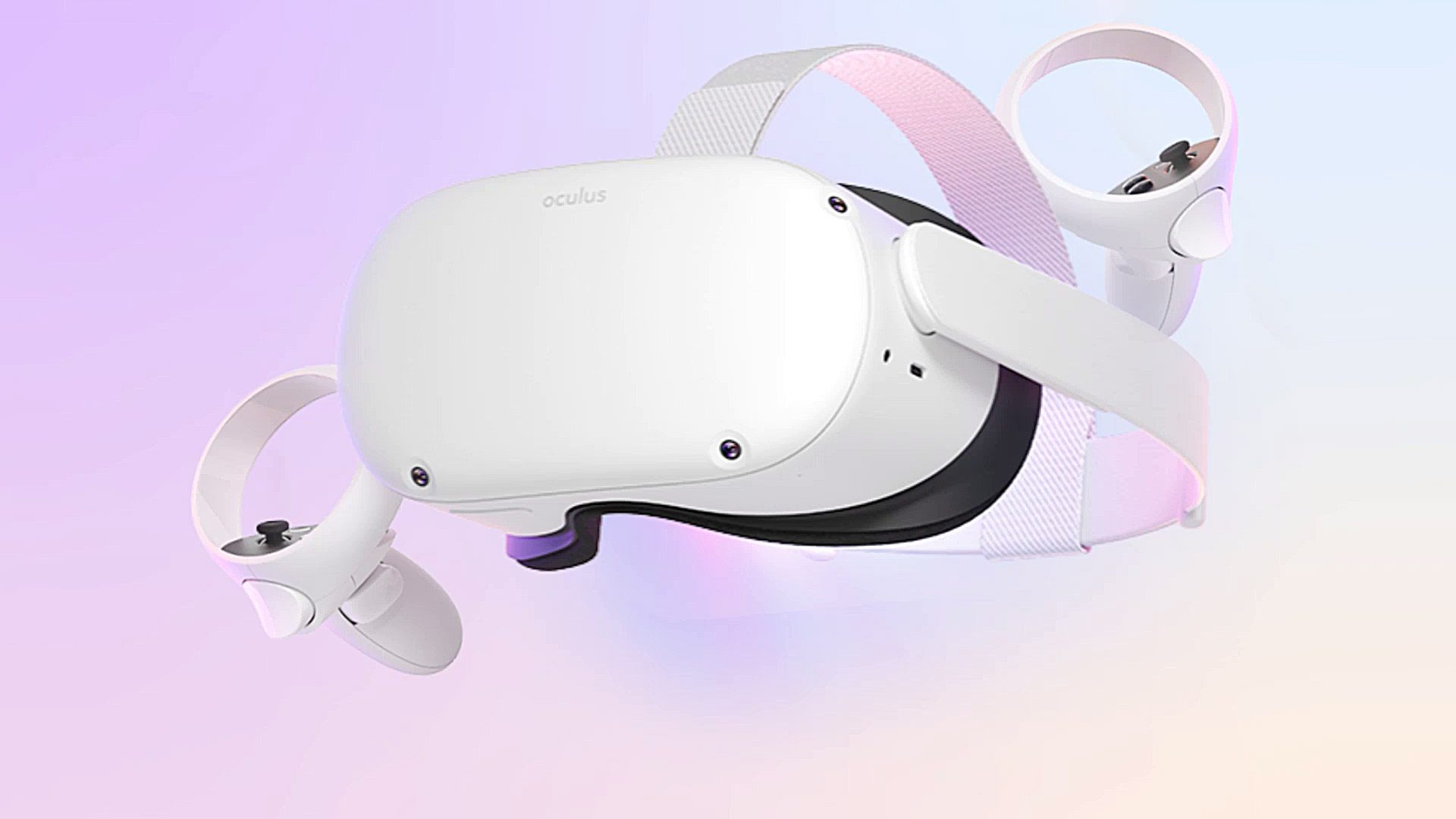
Image courtesy WalkingCat

The single photo shows a white Quest-like headset. There’s no additional info beyond what can be inferred from the image alone, but there are some worthwhile details on display.

Implications of a Missing IPD Slider

Beyond minor changes to the placement of the headset’s tracking cameras, which could facilitate a wider field of view (specifically for improved visibility for hand-tracking), it also appears that headset is missing the IPD slider that’s present on the current Quest. This strongly implies that the next Quest may move from dual displays to a single display, like Rift S uses. That would also very likely mean that the headset would move from OLED display technology to LCD (also like Rift S).

Another possible explanation for the lack of IPD slider is simply that it’s been moved to a position on the headset which isn’t visible in this photo. However, all major headsets have historically placed the IPD slider on the bottom of the headset.

Simplified Strap
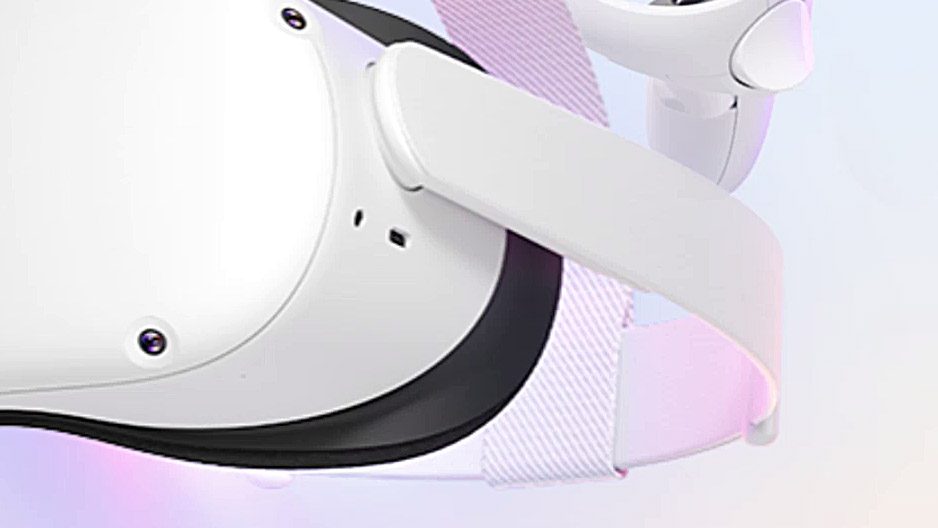
Image courtesy WalkingCat

The headset’s straps are also another notable change. Gone are the velcro side straps which tighten the headset between the front and back. Exactly what will replace that tightening mechanism isn’t clear. Many headsets use a tightening dial on the back of the strap to adjust the fit, but it isn’t clear from the photo that the strap is large enough to contain the necessary mechanism.

The current Quest side-strap is also ‘springy’ (the side struts can stretch from their resting position) to make it easy to put the headset on or take it off without changing the tightness of the straps. It’s possible that this new strap design relies entirely on a spring mechanism to ‘automatically’ achieve the ideal tightness. This would be a welcomed design change as it’s common with the current Quest design to see people tighten the side straps too much for long-term comfort.

Interestingly, the rear part of the strap does away with the large triangular opening that’s designed to catch the ridge of the occipital bone to give the headset some leverage to stay in place. This is generally a desirable feature—a headset would need to be much lighter than the current Quest to go without it.

Possible Return to Original Touch Controller Ergonomics
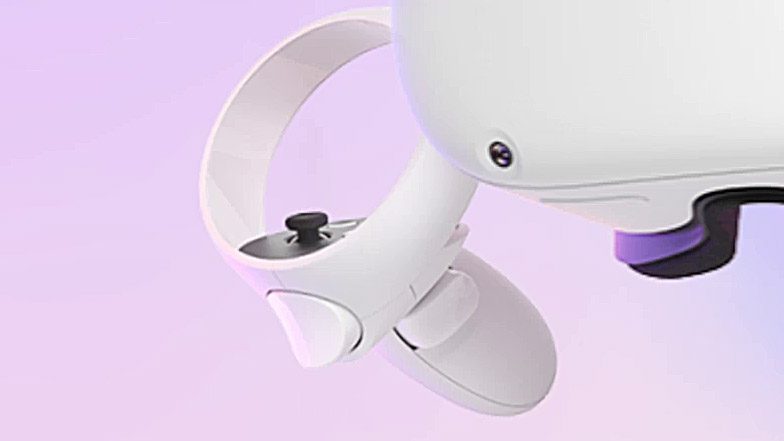
Image courtesy WalkingCat

Another apparent change is a subtle redesign of the controllers which appears to be closer to the original Touch controllers that shipped with first Rift CV1 headset. Among longtime VR users, many preferred the shape and feel of the original Touch controllers to the new design which ships with Quest and Rift S.

The giveaways on the controller redesign is that the index trigger has a more pronounced ridge between its two halves, the grip trigger protrudes more, and the location of the seam along the handle—all of which appear to mirror the original Touch controller. The shape of the ‘face’ of the controllers also appears more round and offset—just like the original Touch controllers—compared to the newer controllers which have a teardrop-shaped ‘face’ that’s perfectly centered with the body of the controller.

What Can’t Be Seen

Beyond what we can see in the photo, various reports have pointed to a new Quest in the works. Earlier this year, Bloomberg claimed that Facebook could launch a new Quest headset as early as late 2020 which would be 10–15% smaller, with a 90Hz or 120Hz display, and a redesigned controller.

A higher refresh rate would be difficult to make much use of with Qualcomm’s Snapdragon 835 chip that’s in the current Quest headset. If Oculus plans to use a 90Hz or 120Hz refresh rate, it will almost certainly need to upgrade the guts of the headset. Newer Snapdragon chips like 855 or XR2 would be a likely choice—Qualcomm did say earlier this year that the first XR2 headsets were expected in the second half of 2020.

– – — – –

While the leaker WalkingCat has a history of authentic leaks, this photo could just as well be a carefully detailed unofficial render that’s an educated guess at what the next Quest might look like. We don’t have independent confirmation of the photo’s authenticity so we’re continuing to treat this as a rumor for the time being.

The post Rumor: Leaked Photo Shows Possible Quest 2 with Headset & Controller Tweaks appeared first on Road to VR.


Ream more: https://www.roadtovr.com/oculus-quest-2-leak-photo-walkingcat/

Oculus Quest HALO Strap Comfort Mod Review (GoQuest VR v3 Pro)


The Go QuestVR v3 Pro HALO strap design is interesting as it's similar to the Oculus Rift S and PlayStation VR strap - Both very comfortable headsets. So is this one as comfortable? Let's find out! ► Check out our VR equipment → https://www.amazon.com/shop/caschary ► Subscribe to see more videos like this one → https://goo.gl/bSJ6L8 This version of the Oculus Quest halo strap is the latest version by GoQuestVR and should be the last update. Here are the timestamps: TIMESTAMPS 00:00 Intro 01:10 In The Box & Pricing 01:56 Setup 04:08 Review 06:18 Optional Top Strap Thoughts 07:27 Headphones Review 08:45 Original Straps Back In? 08:58 Conclusion LINKS - GoQuest VR Halo Strap: https://bit.ly/goquestvr - Previous Quest comfort mod video: https://youtu.be/bIRzy-iyDmE - Watch our Quest tips and tricks video too: https://youtu.be/XxIni9hWp8c - Get an Oculus Quest here (US): https://bit.ly/oculusquest-cc - Get an Oculus Quest (UK): https://amzn.to/2Jip6Zg - Get an Oculus Quest (NL): http://bit.ly/2QlCpd2 (Coolblue) SUPPORT THE CONTENT ► Become our Patron (includes exclusive rewards) → http://bit.ly/PatreonCasandChary ► Become a Sponsor on YouTube (includes exclusive rewards) → http://bit.ly/JoinCasandChary ► Check out our VR Merch → http://bit.ly/casandchary-merch USE OUR LINKS TO SUPPORT US ► VRcover → http://bit.ly/CCVRCover ► VR Prescription Lens Adapters (5% discount code: "CAS&CHARY") → http://bit.ly/CCWidmoVR ► Oculus Quest Comfort Counterweight (5% discount code: "CAS&CHARY") → https://bit.ly/studioform500 ► Play PC VR games with your Quest (10% discount code: "JWGTCASCHARY") → http://bit.ly/CCRiftcat ► More on our website → https://casandchary.com/discount-codes-affiliate-links/ OUR GEAR Our VR equipment → https://www.amazon.com/shop/caschary Full PC Specs → https://casandchary.com/vr-equipment/ GET LATEST UPDATES Twitter → https://twitter.com/CasandChary Facebook → https://www.facebook.com/casandchary/ Instagram → https://www.instagram.com/casandchary/ Join our Discord → https://discord.gg/YH52W2k A special thanks to these Patreon Champs for their support: - BaxornVR: https://www.youtube.com/channel/UC1tmq8Y3jC7gNGvW7asmv1Q - Wintceas - Studioform VR - Andy - Albert - Ben P. - Steve Dunlap - Thomas M. Rice - Andy Fidel - VR Balance - Nathan Schmidt MUSIC Music we use is from Epidemic Sounds → http://bit.ly/CCEpidemicSound DISCLAIMER GoQuestVR sent us a review unit. Per our guidelines, no review direction was received from them. Our opinions are our own. Links in this description may contain affiliate links. We may earn from qualifying purchases from these links (without costing you more). VR on! - Cas and Chary VR #oculusquest #halostrap #casandchary

Oculus Browser Gets Experimental Hand-tracking Support on Quest

A newly released update for the Oculus Browser on Quest includes full-finger hand-tracking support for WebXR projects.

The feature was quietly released in the recent 10.2 build of Oculus Browser, which now comes with a hand-tracking API and timewarp layer support, both of which are considered ‘experimental’ at this time.

The 8.0 version of Oculus Browser released back in February was the first to include initial hand-tracking support for WebXR projects, although it was focused on controller emulation and not true five-finger tracking.

Oculus Browser Product Manager Jacob Rossi announced the news via Twitter, providing some examples via a WebXR test page and layer page which demonstrates hand-tracking and timewarp layer support respectively.

Check out a demo in the familiar WebXR solar system scene featuring the new hand-tracking support:

Hand-tracking came to Oculus Quest as an experimental feature back in late 2019. The intuitive control scheme has since come out of beta and is now available for all Quest owners to use system-wide, letting you control the basic functions of Quest without the need of Touch controllers.

Moreover, there are an increasing number of games and cool experimentations that make use of Quest’s native hand-tracking abilities. We’re hoping to see more soon using the full five-fingered hand-tracking support on Quest.

As for timewarp support, just like on non-WebXR-based apps timewarp support allows the headset to reproject past frames when the scene can’t maintain its native refresh rate, which in Quest’s case is 72Hz.

The post Oculus Browser Gets Experimental Hand-tracking Support on Quest appeared first on Road to VR.


Ream more: https://www.roadtovr.com/oculus-browser-experimental-hand-tracking-support/

Facebook Reality Labs Shows Method for Expanding Field of View of Holographic Displays

Researchers from Facebook’s R&D department, Facebook Reality Labs, and the University of California, Berkeley have published new research which demonstrates a method for expanding the field-of-view of holographic displays.

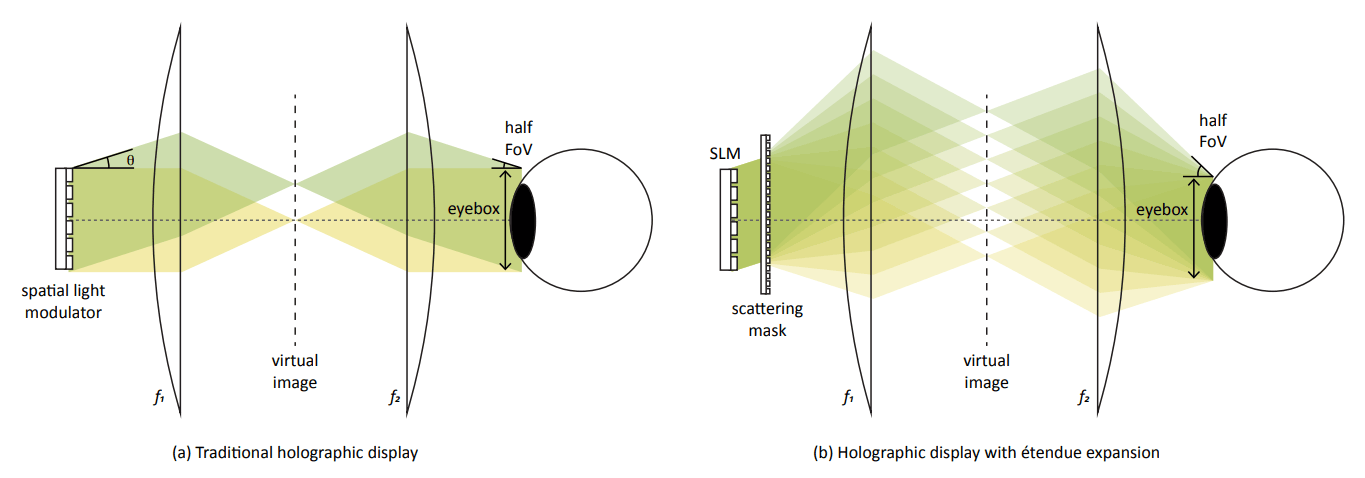
In the paper, titled High Resolution Étendue Expansion for Holographic Displays, researchers Grace Kuo, Laura Waller, Ren Ng, and Andrew Maimone explain that when it comes to holographic displays there’s an intrinsic inverse link between a display’s field-of-view and its eye-box (the eye-box is the area in which the image from a display can be seen). If you want a larger eye-box, you get a smaller field-of-view. And if you want a larger field of view, you get a smaller eye-box.

If the eye-box is too small, even the movement from the rotation of your eye would make the image invisible because your pupil would leave the eye-box when looking any direction but forward. A large eye-box is necessary not only to keep the image visible during eye movement, but also to compensate for subtle differences in headset fit from one session to the next.

The researchers explain that a traditional holographic display with a 120° horizontal field-of-view would have an eye-box of just 1.05mm—far too small for practical use in a headset. On the other hand, a holographic display with a 10mm eye-box would have a horizontal field-of-view of just 12.7°.

If you want to satisfy both a 120° field-of-view and a 10mm eye-box, the researchers say, you’d need a holographic display with a resolution of 32,500 × 32,500. That’s not only impractical because such a display doesn’t exist, but even if it did, rendering that many pixels for real-time applications would be impossible with today’s hardware.

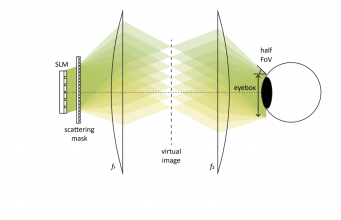
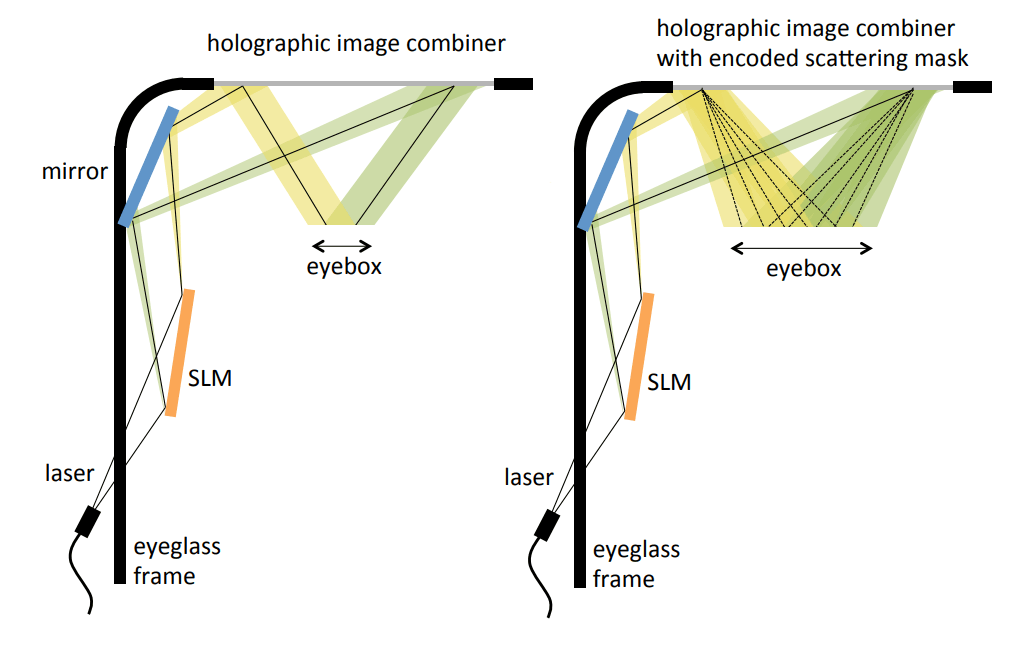
So, the researchers propose a different solution, which is decouple the link between field-of-view and eye-box in a holographic display. The method proposes the use of a scattering element placed in front of the display which scatters the light to expand its cone of propagation (also known as Ă©tendue). Doing so allows the field-of-view and eye-box characteristics to be adjusted independently.

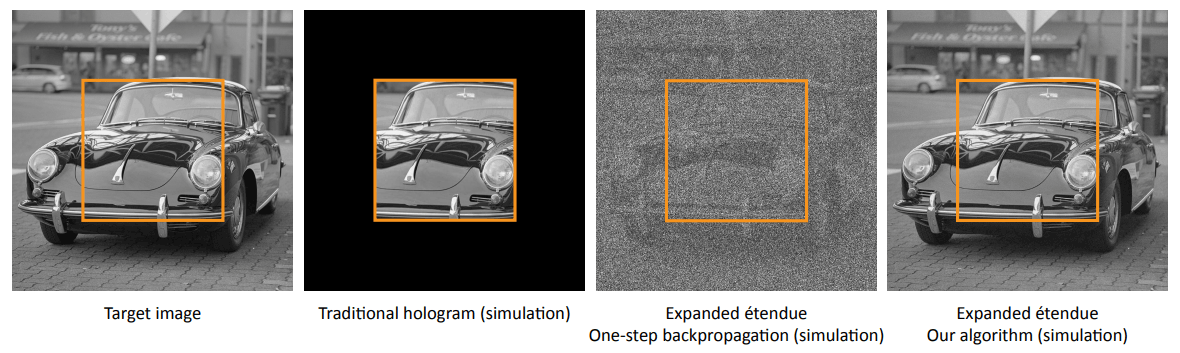
But there’s a problem of crouse. If you put a scattering element in front of a display, how do you form a coherent image from the scattered light? The researchers have developed an algorithm which pre-compensates for the scattering element, such that the ‘scattered’ light actually forms a proper image after being scattered.

At a high level, it’s very similar to the approach that existing headsets use to handle color separation (chromatic aberration) as light passes through the lenses—rendered frames pre-separate colors so that the lens ends up bending the colors back into the correct place.

Here the orange box represents the field of view of a normal holographic display while the full frame shows the expanded field of view | Image courtesy Facebook Reality Labs

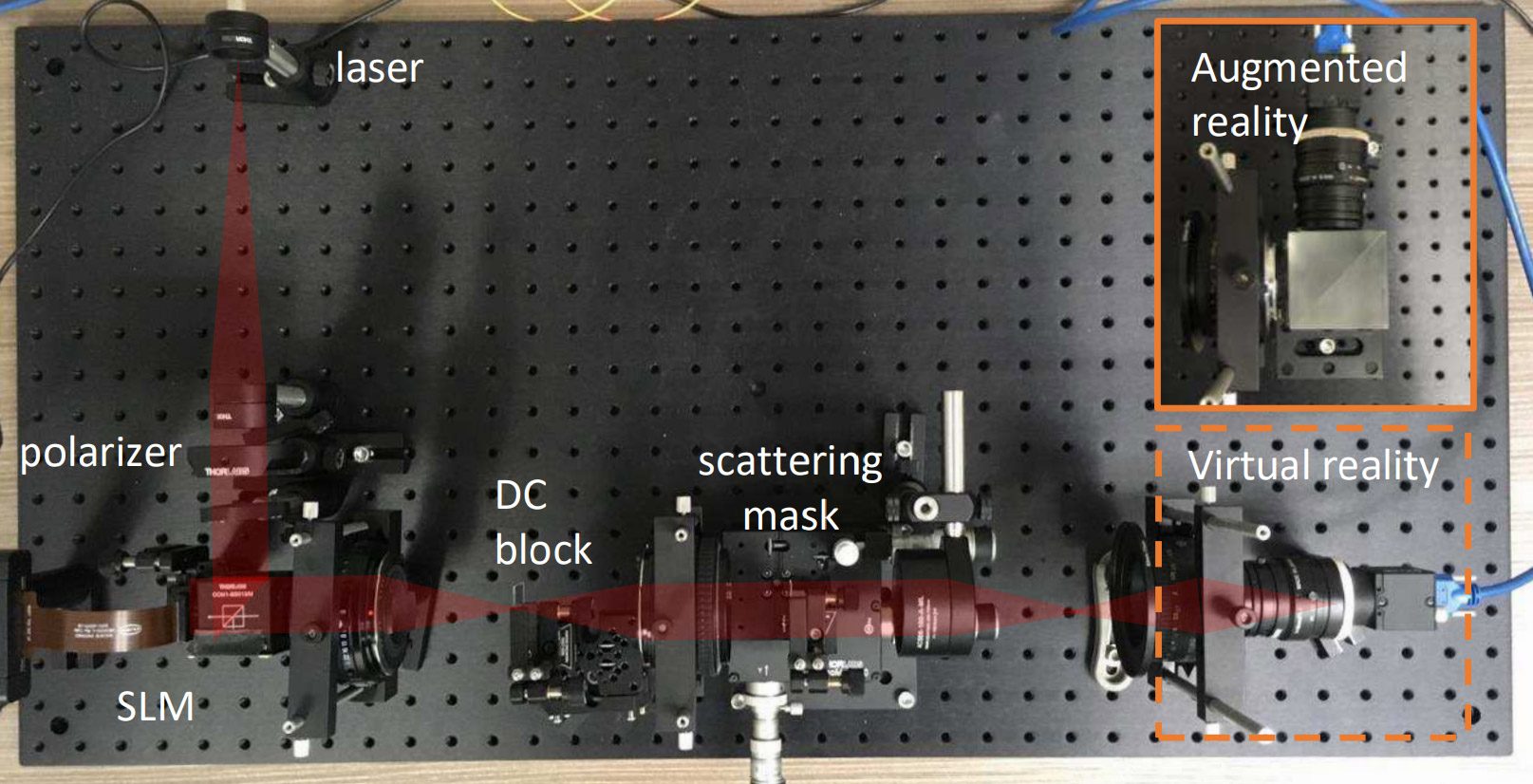
The researchers used optical simulations to hone their algorithm and then built a benchtop prototype of their proposed pipeline to experimentally demonstrate the method for expanding the field of view of a holographic display.

Although the researchers believe their work “demonstrates progress toward more practical holographic displays,” they also say that there is “additional work to be done to achieve a full-color display with high resolution, complete focal depth cues, and a sunglasses-like form factor.”

Toward the end of the paper they identify miniaturization, compute time, and perceptual effects among the challenges needed to be addressed by further research.

The paper also hints at potential future projects for the team, which may be to attempt to combine this method with prior work from one of the paper’s researchers, Andrew Maimone.

“The prototype presented in this work is intended as a proof-of-concept; the final design is ideally a wearable display with a sunglasses-like form factor. Starting with the design presented by Maimone et al. [2017], which had promising form factor and FoV but very limited eyebox, we propose integrating our scattering mask into the holographic optical element that acts as an image combiner.”

Image courtesy Facebook Reality Labs

If you read our article last month on Facebook’s holographic folded optics, you may be wondering how these projects differ.

The holographic folded optics project makes use of a holographic lens to focus light, but not a holographic display to generate the image in the first place. That project also employs folded optics to significantly reduce the size of such a display.

On the other hand, the research outlined in this article deals with making actual holographic displays more practical by showing that a large field-of-view and large eye-box are not mutually exclusive in a holographic display.

The post Facebook Reality Labs Shows Method for Expanding Field of View of Holographic Displays appeared first on Road to VR.


Ream more: https://www.roadtovr.com/facebook-reality-labs-holographic-display-field-of-view-expansion-etendue/

Tuesday, July 21, 2020

Company Raises $30M to Make Programing Industrial Robots Easier With the Help of SteamVR Tracking

In an interesting bit of news which shows Valve’s SteamVR Tracking technology used in a non-VR application, robotics company Wandelbots has raised a $30 million Series B investment around their TracePen tool, a motion-tracked stylus which makes it easy to program the complex movements of industrial robots.

When Valve first introduced its SteamVR Tracking technology (formerly called Lighthouse) in 2015, the company said it envisioned the system being like ‘wi-fi for motion tracking’, in the sense that any device could make use of a shared tracking volume—including non-VR devices.

Germany-based Wandelbots is leveraging the tracking technology for its TracePen product which is designed to make programming industrial robots easier and faster. The company believes that lowering the barrier to robotic programming will enable wider use of robotic automation among companies that haven’t adopted the technology.

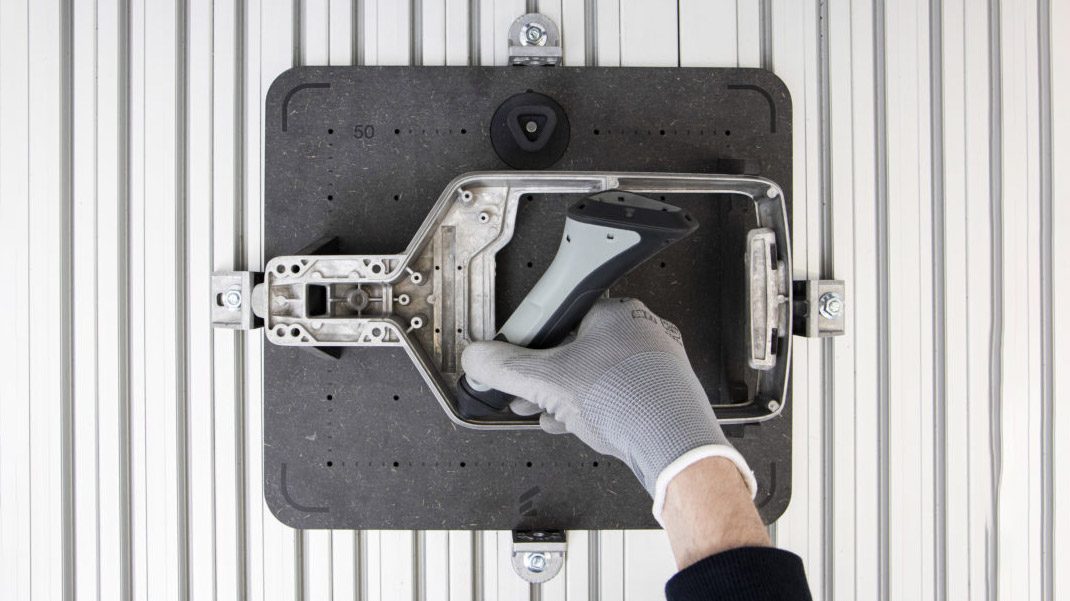
The TracePen product is a kit which includes the stylus (equipped with SteamVR Tracking sensors) and two SteamVR Tracking Base Stations. After setting up the Base Stations and calibrating the movement of the robot by attaching the stylus, the user can use the stylus to simply draw the route the robot should take for its task.

Typically defining these positions would require remote controlling the robot and using 2DOF inputs to guide the arm into each desired position. With full 6DOF tracking of the TracePen and sub-mm accuracy thanks to SteamVR Tracking, defining the positions is as easy as pointing to them with the stylus.

Image courtesy Wandelbots

Once the positions have been defined, the robot can remember and return to them without the need for the Base Stations (thanks to its own IK tracking), which means a single TracePen system can be used to program any number of robots.

Last month, Wandelbots raised a $30 million investment to expand its operations, TechCrunch reported.

SteamVR Tracking is far from the first motion tracking technology to be used for industrial use-cases, but its comparatively extreme portability and low cost make it uniquely suited to this application. Other tracking systems like OptiTrack can offer greater tracking performance but require more expensive and complex setups.

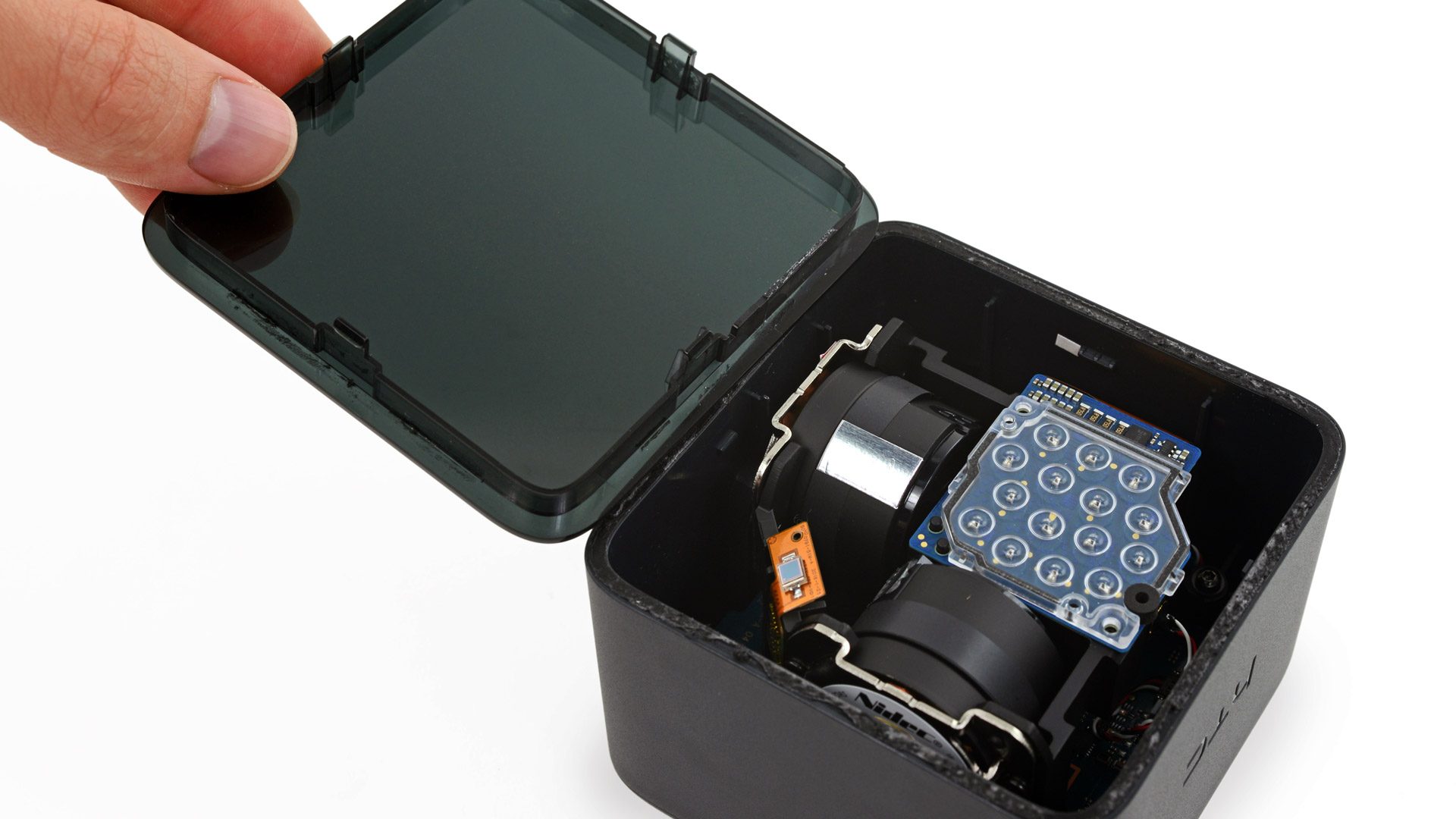
A first-generation base station. Rather than a camera like many tracking systems, SteamVR Tracking uses sweeping IR lasers and IR pulses which are sensed by the tracked object. | Image courtesy iFixit

The unique architecture of SteamVR Tracking is a significant reason for its versatility; most active tracking systems require the tracked object to be able to communicate with the thing that is tracking them. In the case of SteamVR Tracking, the external base stations don’t need to know anything about the tracked object. They simply send out a signal which can be be used for tracking by any object in the volume, without any ‘pairing’ procedures or any centralized host (ie: you could have several devices with independent compute tracked in the same volume at the same time).

Wandelbots TracePen also isn’t the first non-consumer application of SteamVR Tracking outside of headsets. Logitech for instance has created a VR stylus, which uses Valve’s tracking tech and is designed to be a more precise input device than the VR controllers that come with consumer VR headsets. Companies like Tundra Labs sell hardware which any company can use to build a product based on SteamVR Tracking, and HTC’s Vive Tracker is a general-purpose tracking puck which can be used to add SteamVR Tracking to anything.

The post Company Raises $30M to Make Programing Industrial Robots Easier With the Help of SteamVR Tracking appeared first on Road to VR.


Ream more: https://www.roadtovr.com/wandelbot-tracepen-steamvr-tracking-series-b-investment-30m/

Watch ‘Dreams’ Upcoming VR Mode in Action Before It Releases Tomorrow

The big PSVR update to Media Molecule’s creation game Dreams (2020) is coming tomorrow, July 22nd. If you’re counting the seconds though, you can catch an insider look right now as Media Molecule is going hands-on with the ‘Inside the Box’ starting experience and a number of the game’s new VR creation features.

In the video, we’re given a timely look at the VR version of the game. The update is coming part and parcel with a new labeling system which lets you easily filter through content, and label your content as both VR-only or VR-compatible. Notably, most user-built content is said to be playable in VR, although we want to see it to believe it first.

The team at Media Molecule went on to show off the creation tools whilst creating a VR experience, using its new gadgets such as the character tool that lets you snap things in front of you FOV, which is particularly useful for creating your own UI or HUDs.

Another gadget allows creators to sculpt bespoke items and then, for example, bind it to the position of the controller, which can let you create a weapon that is matched up properly with the position of either supported controllers, be it PS Move controller or Dual Shock 4.

The stream is still ongoing at the time of this writing, so we’re watching along with you and updating this piece as we go. Otherwise, the full presentation will be available below in full when it’s finished.

The post Watch ‘Dreams’ Upcoming VR Mode in Action Before It Releases Tomorrow appeared first on Road to VR.


Ream more: https://www.roadtovr.com/dreams-vr-create-mode-media-molecule/

ILMxLAB: ‘Star Wars: Tales from the Galaxy’s Edge’ First Look Coming July 28th

ILMxLAB today announced that its upcoming VR experience Star Wars: Tales from the Galaxy’s Edge is getting a ‘first look’ next week, July 28th, which should hopefully demystify the studio’s next built-for-VR original story.

Update (July 21st, 2020): ILMxLab say that on July 28th via its @ILMxLAB Twitter account it will be showing off the “first story details” of Star Wars: Tales from the Galaxy’s Edge. We’re hoping for a trailer at the very least, and possibly a more granular release date. Up until now, all images have been specified as ‘concept art’.

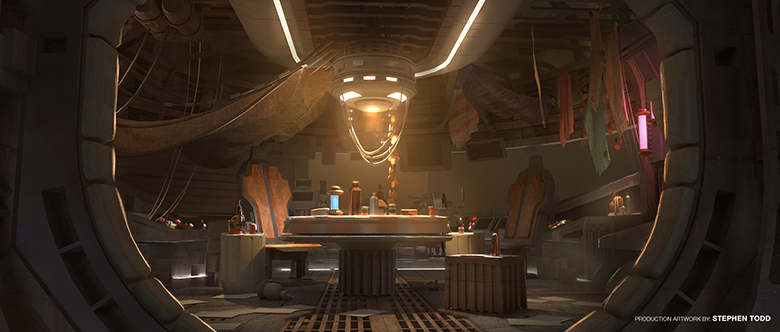
The Oculus blog post also included a new concept image (created by ILMxLab’s Stephen Todd), showing off what seems to be a base area, embedded above the original article.

Image courtesy ILMxLAB

Original Article (May 28th, 2020): The new VR experience is said to take place sometime between Star Wars: The Last Jedi (2017) and Star Wars: The Rise of Skywalker (2019) on the planet of Batuu, this time bringing VR users to the outskirts of Black Spire Outpost of ‘Star Wars: Galaxy’s Edge’, the location-based Disneyland attraction. Black Spire Outpost, the largest settlement on Batuu, is an “infamous stop for traders, adventurers, and smugglers traveling around the Outer Rim and Wild Space,” the official Star Wars website says.

The studio says in an Oculus blog post that the original story will include “multiple styles of gameplay and difficulty settings to bring in a wide variety of players” when it arrives later this year.

And if you’re wondering whether this too will be an Oculus platform exclusive, ILMxLAB is working directly with Oculus Studios to make it happen, so that’s a big yes.

“We’re very happy to collaborate with ILMxLAB again on Star Wars: Tales from the Galaxy’s Edge,” says Facebook VP of Content, AR/VR Mike Verdu. “VR is an incredibly powerful storytelling medium; this experience will immerse fans in a deep and thrilling adventure within the Star Wars galaxy, as they are transported to impossible places through the power of virtual reality.”

There’s no word on exactly when it’s set to release, or which platform we’ll be seeing Star Wars: Tale from the Galaxy’s Edge on first. If it follows in the footsteps of the Vader Immortal triology, we could be seeing another Quest-first release.

The post ILMxLAB: ‘Star Wars: Tales from the Galaxy’s Edge’ First Look Coming July 28th appeared first on Road to VR.


Ream more: https://www.roadtovr.com/star-wars-tales-galaxys-edge-vr-ilmxlab/

At $600K, Tundra Tracker Smashes Kickstarter Goal in Less Than 24 Hours

Tundra Tracker, the SteamVR Tracking tracker in development by Tundra Labs, has well exceeded its $250,000 Kickstarter goal in less than 2...