Wednesday, February 3, 2021

Oculus App Lab Lets Devs Distribute Apps on Quest While Bypassing Curation Process

Oculus today introduced a program called App Lab, a new effort which will allow developers to distribute their VR apps on Quest without being subject to a quality review ‘curation’ process. Though apps still need to meet Oculus’ technical guidelines, and won’t appear in the Quest store like formally approved apps, they can be independently distributed and even sold without a cumbersome sideloading process.

With Quest, Oculus introduced a ‘curated’ approach to the headset’s app store. Since launch, any app published on the Quest store has needed to meet technical, content, and quality guidelines. That means Oculus has manually reviewed each application and made a judgement call on whether or not it meets the quality bar it’s hoping to maintain. This has meant that many developers who would like to offer their apps on Quest have been barred from doing so.

Oculus has now delivered a long promised workaround that makes it easier for developers to distribute their apps on the headset, even if the company isn’t yet ready to include them in the store.

Called App Lap, the program allows developers to upload their app to the Oculus store infrastructure and create essentially the same app product page that approved apps get to use. The only major caveat is that App Lab apps won’t be shown to users who are browsing the usual Quest store. This leaves it up to developers to point their audience to the app’s product page. Luckily, as long as users know the exact name of the app, they can even find it with a search in the regular Quest store search.

In order to be part of App Lab, apps still need to follow Oculus’ technical and content guidelines (meaning no adult apps, or other content which is against the company’s policies), but apps will not be reviewed for quality.

What’s more, App Lab apps can be free or paid, and will appear in the user’s Quest library just like any other app the user owns. App Lab apps can even be updated through the same automatic update process as apps in the Quest store, and can access “the majority of standard platform features, including automatic update distribution, platform integration and SDKs, app analytics, release channels, and more,” Oculus says.

Today’s announcement of App Lab also sees the release of the very first applications to use the program:

– – — – –

App Lab, which allows developers to skirt Quest curation, is a more streamlined approach to unofficial distribution channels which have relied on ‘sideloading’. Sideloading is intended to allow developers to load and run applications directly on Quest without downloading through a hosted platform. However, this also functioned as a back door for users to run applications downloaded outside the store.

A popular platform and application, called SideQuest, sprung up to formalize that process, effectively creating an unofficial Quest store for users to easily browse, download, and sideload apps onto their headset.

Fortunately, Oculus has embraced SideQuest, and worked directly with the creators to allow SideQuest product pages to point users directly to App Lab hosted apps. “Because App Lab apps do not require sideloading, developer mode, or a PC to install, we expect that this support will dramatically increase the reach of SideQuest apps that use App Lab for distribution,” Oculus says. “SideQuest supports App Lab apps starting today, and community-focused platforms of that nature may play a bigger role in Quest’s future.”

Beyond providing an avenue for experimental and less polished games to be distributed on Quest, App Lab will also make it easier for non-game applications to make it onto the headset.

The post Oculus App Lab Lets Devs Distribute Apps on Quest While Bypassing Curation Process appeared first on Road to VR.


Ream more: https://www.roadtovr.com/oculus-app-lab-quest-independent-distribution/

Tuesday, February 2, 2021

‘Beat Saber’ Has Sold 4M Copies & 40M Songs, an Estimated $180M Revenue (and Accelerating)

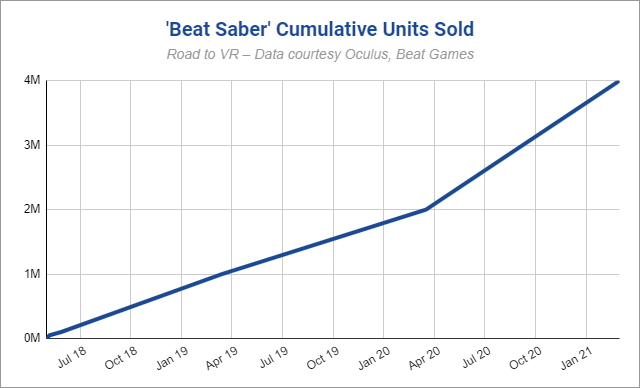
Beat Saber has officially reached 4 million units sold, Oculus today announced, along with 40 million songs of paid DLC, pushing the app’s estimated revenue to $180 million.

By now, Beat Saber can be considered nothing less than VR’s first killer app by scale. As far as we know, it’s the best selling VR game to date, now with 4 million units sold across all platforms (Quest, PC VR, and PSVR).

Oculus also confirmed the game has sold 40 million paid DLC songs, the equivalent of selling 40 platinum music albums on top of the game’s base music.

We estimate Beat Saber’s total revenue around $180 million, with the following assumptions:

  • 1 million copies sold at the early access price of $20
  • 3 million copies sold at the retail price of $30
  • 20 million songs bought individually at $2 each
  • 20 million songs bought bundled at $1.50 each

And the pace is only accelerating. Thanks to various sales milestones shared since the game’s release in May 2018, we can more clearly see the change in rate of sales over time by looking at the average number of units sold per day.

While VR developers with titles on Quest are seeing growing success, most are still far from Beat Saber’s scale. For perspective, The Walking Dead: Saints & Sinners, which is considered a success, recently announced $29 million in revenue. That equates to around 725,000 units sold; granted, the game has only been available for around a year, and even less time on Quest. Oculus today also shared that only five titles other than Beat Saber have exceeded $10 million in revenue on Quest alone.

Facebook clearly identified the app’s potential, as it opted to acquire Beat Games, the studio behind the title, in late 2019. Since then, the studio has released additional music packs and a major update to the game which added multiplayer functionality.

The post ‘Beat Saber’ Has Sold 4M Copies & 40M Songs, an Estimated $180M Revenue (and Accelerating) appeared first on Road to VR.


Ream more: https://www.roadtovr.com/beat-saber-4-million-units-milestone-revenue/

‘STRIDE’ is Finally Coming to PSVR, Bringing Mirror’s Edge-style Action in Early 2021

The high-flying shooter STRIDE (2020) from developer Joy Way is finally making its way to PSVR, with release set for sometime in early 2021.

The Mirror’s Edge-style game is slated to include all of the recent most additions from the PC VR version, including ‘Arena’, ‘Time Run’, and ‘Endless’ modes. There’s no official release date yet for the PSVR version, however Joy Way says to “stay tuned.”

Stride offers up parkour challenges that let you sail across rooftops and shoot down hordes of gun-totting baddies in cinematic slow motion. You can also grab ledges, vault through windows, slide down cables, and swing from hooks, making you feel like a true action hero.

Joy Way says it’s still working on a story mode for the game, so it’s uncertain whether that will make it to PSVR on launch day or we’ll still have to wait. Either way, it’s definitely worth a play.

With a PSVR release coming soon, it raises the question whether Oculus Quest will be getting Stride as well. There’s still no word on when/if a Quest version is in the pipeline, however the chances are good. Now optimized for the more humble PS consoles, it gives the studio a clear incentive to release on the standalone Quest platform—especially since unit sales on Quest tend to offer up to 10 times the return as opposed to their PC VR counterparts.

The post ‘STRIDE’ is Finally Coming to PSVR, Bringing Mirror’s Edge-style Action in Early 2021 appeared first on Road to VR.


Ream more: https://www.roadtovr.com/stride-psvr-mirrors-edge-release-date/

How to Watch the Super Bowl in VR With Friends for Free

Due to the ongoing pandemic, this year’s Super Bowl is set to be very different. If you have a VR headset though, you can still host that Super Bowl Sunday party with your buddies while staying safe at home. Here’s how you can watch the Super Bowl in VR for free with with your friends using the Oculus Quest, Oculus Rift, and all SteamVR-compatible headsets.

There won’t be any 360 immersive video options to watch the game like in years past, however you can leverage VR to watch the normal TV broadcast of game in a huge virtual theater where you’re sitting right next to your VR headset-owning pals.

For this method to work you just need two things:

1. At least one PC user with access to a stream of the Super Bowl on their computer (CBS will stream the Super Bowl for free without any subscription at CBSSports.com).

2. A headset that supports the Bigscreen app (free).

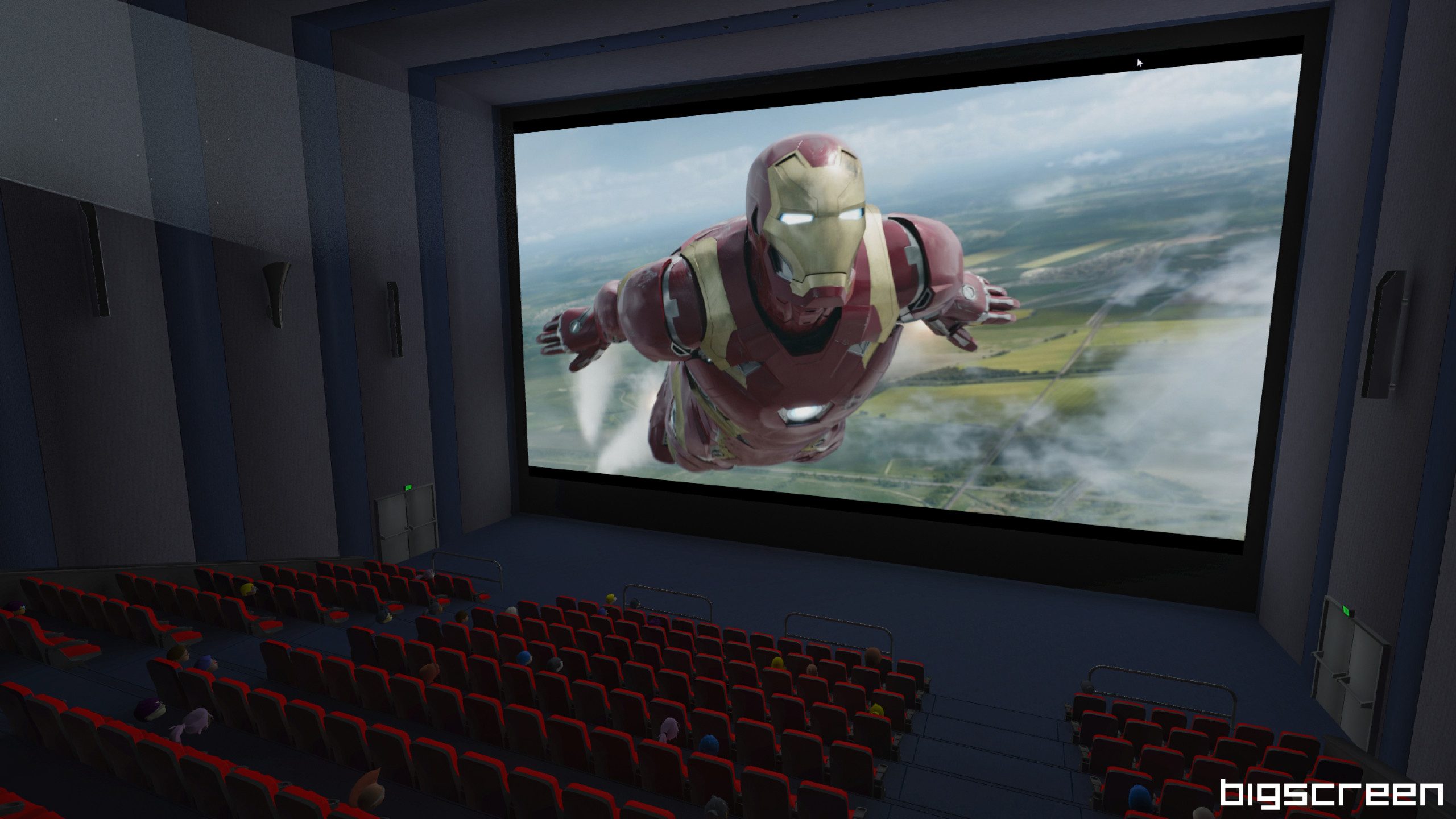
Bigscreen is a cross-platform VR app that lets you and multiple friends get together in a virtual reality personal theater where you can stream your computer’s desktop screen onto a huge virtual screen that everyone can see.

Image courtesy Bigscreen

Bigscreen is free and available on Steam (supporting Vive, Rift, and WMR), Oculus (supporting Rift, Quest), and WMR (supporting Windows VR headsets). Luckily, Bigscreen is also cross-play between all of these headsets, so even if your friends have different headsets you should have no problem watching together (note that Bigscreen unfortunately doesn’t support PSVR).

Once everyone who will join your social viewing of the Super Bowl in VR has downloaded the Bigscreen app on their headsets, the rest is pretty easy.

How to Watch the Super Bowl in VR With Friends using Bigscreen

Note: Thanks to its 100+ streaming channels, the app also provides public access to CBS Sports. however it’s a public room so it may not be best for party viewing. Until Bigscreen makes streaming TV available in private rooms, we’re suggesting the following tips for now:

1. Select someone in your group with access to the Super Bowl stream on their PC to be the host (it will be easiest if the host is also using a VR headset on their PC, but if no one in your group is using a PC VR headset, you can still stream your PC’s view into mobile headsets by following these instructions). Ideally your host will be whomever has the best bandwidth so that guests will see decent quality when streaming the Super Bowl in VR (easily check your bandwidth here).

2. Have the host launch the Bigscreen app and select the ‘Create a Room’ button under the ‘Browse Multiplayer Rooms’ tab (house icon). Give the room a name (select ‘Big Room’ if you plan to have more than four friends watching). Set the room to Private, unless you are open to strangers joining your viewing.

3. Once the room is created, click the ‘Invite Your Friends’ button and copy the Room ID and share with guests who will join the viewing (the Room ID looks like this: room-uqaebpj4). Guests will enter this Room ID into their Bigscreen apps to join your session once it has been created.

4. Now the host should put on their VR headset and use their floating desktop screen to pull up the Super Bowl stream on their computer. Once the stream is playing, open the Bigscreen interface and click ‘Display on the Big Screen’ (this will now show your monitor to everyone in the room).

5. Click the Desktop Audio button (speaker icon) to allow guests to hear the stream audio. (if you or your guests are hearing echoing audio, check this support page)

6. Kick back and enjoy watching the Super Bowl in VR with your friends in a multiplayer personal theater.

Tips for maximizing your social Super Bowl in VR viewing experience:

  • Any stream will work: This method will work with any Super Bowl stream, whether it’s the official stream through CBS in a browser, or another stream through a TV provider’s PC app. As long as the host can get a video of the game to show on their monitor, you’ll be able to stream the video into Bigscreen for friends to see.
  • Test ahead of time: It’ll take you a few minutes at least to find your way around Bigscreen. Don’t risk missing the kickoff, be sure to test ahead of time to iron out any issues.
  • Move your screen: When you first get into Bigscreen, anyone on PC will have a small screen floating in front of them which is sometimes in the way. Using your controller you can point to the screen and drag it out of the way, or use the ‘Customize your screen’ tab (monitor icon) on the Bigscreen interface to make further adjustments.
  • Pick the ideal viewing environment: Bigscreen offers a range of environments from a modern living room with a projector screen to a huge movie theater cinema. Use the ‘Choose an environment’ tab (world icon) to pick the one that suits you.
  • Bandwidth = quality: The more people in the room, the more upload bandwidth the host will need to ensure guests are seeing good quality video in their headset. If guests are complaining that quality is low, the host can adjust the streaming quality to reduce bandwidth. In Bigscreen, use the Settings tab (gear icon) and Multiplayer menu turn down the ‘Video Stream Resolution’ option until guests are consistently seeing smooth video. As a last resort, consider changing the room environment to any of the environments with the green leaf icon, which reduces the performance demands on the host PC.

Update (February 2nd, 2021): Included all supported platforms and additional links for livestreams.

The post How to Watch the Super Bowl in VR With Friends for Free appeared first on Road to VR.


Ream more: https://www.roadtovr.com/watch-super-bowl-in-vr-with-friends-free-remotely-social-multiplayer/

This Developer’s VR Vacuuming Game Gives a Peek into the Future of Gamified Chores

Completing your weekly chores can be an absolute drag, but doing repetitive tasks like vacuuming the house might not always be so boring when VR and AR come into the mix.

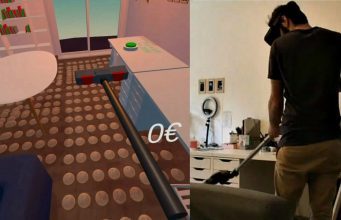
Reddit user ‘VoxelGuy‘ showcases a novel idea with a VR prototype vacuuming minigame built around a 1:1 virtual representation of his living room, which he initially created for a few other cool ‘virtual-augmented’ reality experiments.

With it, VoxelGuy vacuums up virtual Euros using an Oculus Quest and Touch controller strapped to a physical vacuum cleaner; he envisions the in-game currency could be used to buy virtual decorations or new room skins to make it even more immersive.

For now, Voxel Guy’s minigame is a tailor-made prototype, which he made by recreating his own space in Unity. It’s a fun idea though that shows that chores could be, well, less of a chore one day.

Still, it may be a bit too soon for such a game to come to either VR or nascent AR app stores near you. Critically, even with its ability to detect and define obstacles via its Guardian boundary, Oculus Quest lacks the ability to detect a fine level of object granularity on the fly, such as the grit and grime that inevitably finds its way into every possible nook of the room. Also, if you miss a big piece of lint, and you wouldn’t really have a way of knowing since the space is 100 percent virtual.

Ideally, it could be more suited to a VR device with detailed room-mapping and high resolution RGB color pass-through, so users could adapt the game to their own spaces automagically, and choose which items are represented purely in the virtual space and which ones can be seen directly by the user, like the floor itself. That’s not available on consumer VR headsets now, but it could be in the future.

Adapting it to a bona fide AR headset, like HoloLens 2 or Magic Leap 1, could be a fitting target platform too. With it, you’d only need to represent a few items virtually, such as the coins and decorations. Considering however that very few people actually own such an AR headset—high prices keep them well out of reach of consumers—a version of VoxelGuy’s prototype could approach ‘killer app’ territory when device costs inevitably come down. Also, a cordless vacuum would be nice too.

VoxelGuy has a load of other experiments too, such as his space-themed escape room game, which uses his own furniture as props. If you’re interested in learning how to create these sort of ad hoc virtual rooms yourself, check out VoxelGuy’s guide on how to recreate any room in Unity and deploy it on Oculus Quest.

The post This Developer’s VR Vacuuming Game Gives a Peek into the Future of Gamified Chores appeared first on Road to VR.


Ream more: https://www.roadtovr.com/ar-vr-gamified-chores-vacuuming/

VR’s 2021 Outlook: 14 Indicators in One Place

Hard data on the VR market is often hard to come by, while broad ‘industry reports’ are often so general that it’s difficult to see what things look like ‘on the ground’. To get a sense of VR’s outlook in 2021, we’ve collected 14 of the most recent and concrete indicators for your perusal.

Oculus Quest

Zuckerberg: Quest 2 ‘on track to be first mainstream VR headset’, Next Headset Confirmed

Key Data Points:
  • Quest 2 sales drove Facebook’s Q4 non-advertising revenue to $885 million, a 156% increase year-over-year
  • More than 60 Oculus developers have reached $1M+ revenue
  • Estimates based on this data suggest between 500,000 and 1,000,000 Quest 2 units sold in Q4 2020 alone
  • Zuckerberg claims Quest 2 is “on track to be the first mainstream virtual reality headset,” and confirms the next iteration of the headset is in development

Takeaway: Thanks to Quest 2’s performance, Facebook is more bullish than ever on VR. While Zuckerberg in years past has described the company’s VR work as long-term investments not expected to pay out for years; he says about the company’s latest results, driven by Quest 2, “I think that this quarter’s results show that this future [that we’ve been working toward in VR] is here.”


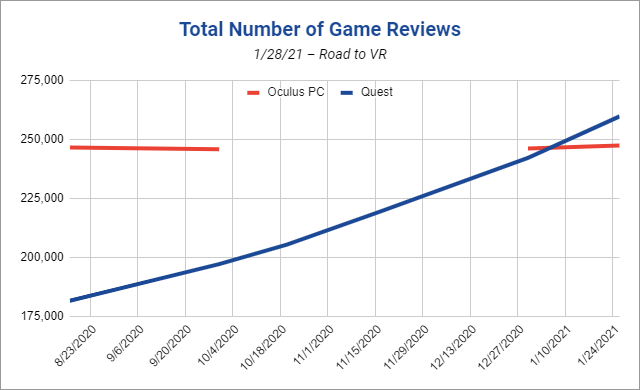
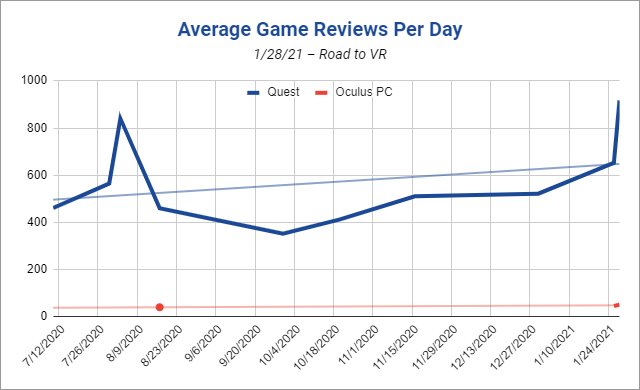
Total Quest Games Reviews Have Exceeded Oculus PC Reviews in Less Than Two Years

Key Data Points
  • The total count of game reviews on the Quest store have surpassed those of the Oculus PC store (see chart)
  • The Quest store is seeing many times more reviews per day on average (see chart)
  • 79% of Quest games have surpassed 100 reviews, compared to just 19% of Oculus PC games
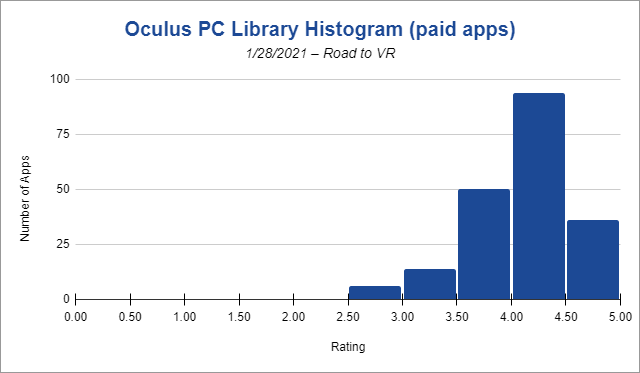
  • Games on the Quest store are also rated higher on average than games on the Oculus PC store (see chart 1, chart 2)

Takeaway: These signals show Quest’s momentum compared to Oculus PC, and why Facebook is largely abandoning the latter. Valve, however, continues to support the PC VR ecosystem through SteamVR, and will likely get a boost in growth as a result of users abandoning the Oculus PC ecosystem.


PC VR

Facebook to Discontinue Rift Product Line in 2021, Will No Longer Build PC-only VR Headsets

Key Data Points:
  • Facebook betting the future of VR on standalone headsets like Quest 2
  • Not just the Rift S will be discontinued this year, but the entire Rift product line (no more PC-only headsets from Facebook)
  • Players can continue to use Quest with a PC thanks to Oculus Link which allows the headset to plug into a capable computer to use high-end VR content

Takeaway: Once a leader in the PC VR space, Facebook seems content to leave that portion of the market to someone else (namely, Valve). While Quest and Quest 2 can continue to work with a PC by plugging in, the company’s PC VR store has been left to languish. Facebook believes affordable standalone headsets will capture the mainstream market it’s seeking


Valve: Steam Saw 1.7 Million New VR Users in 2020, 71% Increase in VR Game Revenue

Key Data Points:
  • 1.7 million new VR users on Steam in 2020
  • 104 million VR sessions on Steam in 2020
  • Average VR session playtime in 2020 was 32 minutes, a 30% increase year-over-year
  • VR game revenue on Steam grew by 71% year-over-year (Half-Life: Alyx accounts for 39% of that growth)

Takeaway: Steam may not have seen the breakout success of Quest in 2020, but the platform continues to grow. A large portion of revenue growth in 2020 came directly from Half-Life: Alyx, which shows the game cementing its mark as one of VR’s killer apps.


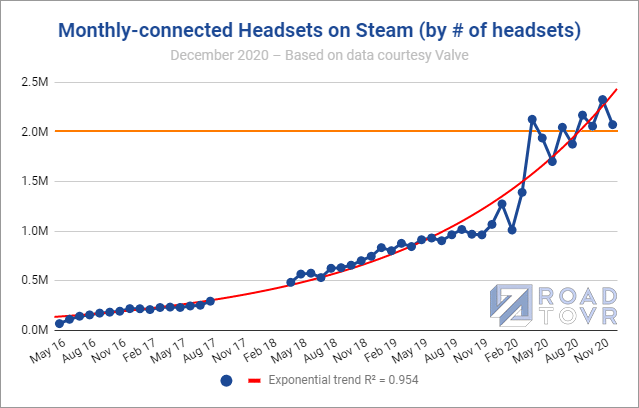
Analysis: Monthly-connected VR Headsets on Steam Pass 2 Million Milestone

Key Data Points:
  • Monthly-connected headsets on Steam reached 2 million for the first time in 2020
  • 2 million headset milestone first reached in April 2020, but now held consistently for four months running, with an all-time high in November 2020 at 2.3 million (see graph)
  • It took 40 months for Steam to reach 1 million monthly-connected headsets, but just 7 more months to reach 2 million
  • Monthly-connected headsets up 94% year-over-year

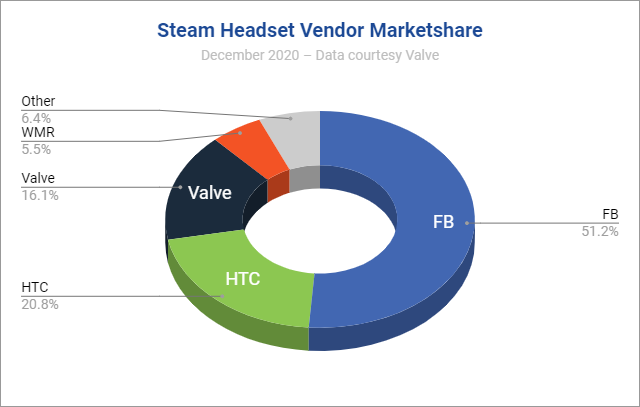
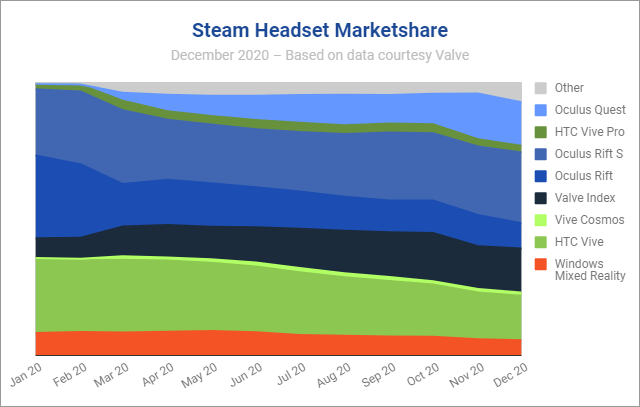
Takeaway: The number of Steam users with VR headsets continues on a strong growth trajectory. While Facebook headsets make up 51% of connected headsets (see graph), a larger number of induvial headsets now hold sizeable shares, showing increasing competition and choice for consumers (see graph). The five most popular headsets on Steam are: Rift S, HTC Vive, Oculus Quest, Valve Index, and Rift.


Despite Shortages, Valve Index Among Steam’s 5 Top-grossing Products for 13 Weeks Straight

Key Data Points:
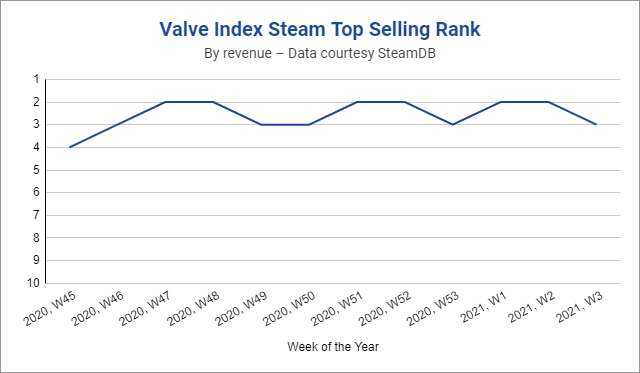
  • Index has been among the 5 top-grossing products on Steam for 13 weeks running (see chart)
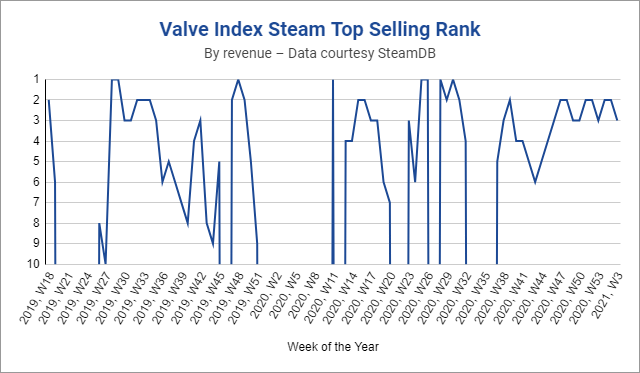
  • The headset has also peaked as the #1 grossing Steam product on eight separate occasions since release (see chart)

Takeaway: Index may not be selling in massive numbers, but its big price tag means it has been earning as much if not more revenue than many major games on Steam. The data suggests that Index has been a significant revenue stream for Valve—likely much larger than Half-Life: Alyx—showing that the enthusiast VR segment is willing to shell out cash for high-end headsets.


PlayStation VR

PSVR Continues to Sell but Slows in Light of Quest and Newer Headsets

Key Data Points
  • Sony is believed to be the long-running leader in VR headset sales, but the company has not committed to building a next-gen headset, even four years after the release of PSVR
  • PS5 requires an adapter to work with PSVR, and only runs VR games in PS4 backwards compatibility mode

Takeaway: Sony has been a leading player in the VR space since the early days but its enthusiasm for the medium waned significantly in 2019 and 2020 as it ramped up to launch PS5. The company has plainly avoided saying anything about its near-term VR roadmap, and some developers have taken this as a sign to focus their VR efforts elsewhere. While not fully responsible, it’s likely that the affordable and standalone Quest has taken some of the wind from PSVR’s sails.


VR Content

For a Veteran Studio That’s Weathered the Storm, VR Has Become a Lucrative Business

Key Data Points
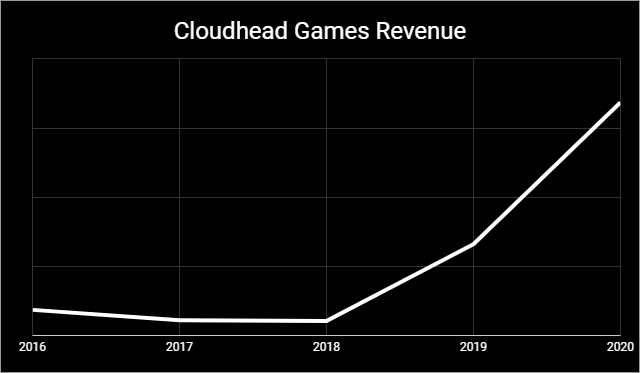
  • VR studio Cloudhead Gamers shared a graph showing its relative revenue from 2016 through 2020 (see graph)
  • December 2020 revenue grew 60% year-over-year
  • In 2020, unique users that played the studio’s game grew by 131% year-over-year

Takeaway: Cloudhead Games is one of the most veteran VR studios in the industry. CEO Denny Unger revealed the many ups and downs the studio and the industry at large has seen since the launch of the first consumer VR headsets to today. Cloudhead saw the initial VR launch hype dying down by 2018, leaving the studio on the verge a pivot away from VR. Thanks to a new perspective on VR game design culminating in its latest title, Pistol Whip, and the launch of Oculus Quest, the studio has seen new levels of success in 2019 and 2020.


Google Makes ‘Tilt Brush’ Open Source as Active Development Comes to a Halt

Key Data Points:
  • Google formerly ceased development on Tilt Brush, a VR painting app which has been called an early VR ‘killer app’ by some
  • Though official development comes to a halt, Google open-sourced the project so that it can live on

Takeaway: Though Google was very bullish on VR through 2016 and 2017, the company didn’t see the traction it hoped for with Daydream, it’s Android-based VR platform. Having largely dropped its VR ambitions by 2018, the fact that Tilt Brush lasted as long as it did is somewhat surprising. Alas, the company’s history of shutting down projects made this a likely eventuality. For companies like Google, which are only interested in projects that quickly find significant traction, VR remains a difficult sector to enter because the use-cases which can drive mass scale are still limited by the quality and cost of VR hardware.


‘The Walking Dead: Saints & Sinners’ Surpasses $29M in Revenue

Key Data Points:
  • The Walking Dead: Saints & Sinners reached $29 million revenue in just one year
  • In a little over three months, the Quest version of the game sold 10 times better than the Oculus PC version despite being available for one year

Takeaway: Though the VR gaming market is still small compared to the non-VR gaming market, small teams that understand the medium are finding growing success. The Walking Dead: Saints & Sinners comes from a small studio which has been immersed in VR development since the early days, and has found a strong product-market fit. Quest is increasingly becoming a top priority as a target platform for VR content among studios hoping to maximize their customer base.


‘Rec Room’ Now Has Over 1 Million Monthly Active VR Users

Key Data Points:
  • Social VR app Rec Room has surpassed 1 million monthly active VR users, making it one of the most frequently trafficked VR apps thus far
  • Daily active VR users are spending an average of 2.7 hours per day in Rec Room
  • Quest 2 users make up about half of the app’s VR population

Takeaway: Social VR applications which also provide activities for users to partake in (rather than just chat rooms) are emerging as increasingly popular apps, though supporting both VR and non-VR players seems to be a key component to growth. Apps like Rec Room and VRChat have both benefited from that approach, as well as growth powered by a broad increase in digital entertainment in 2020 as a result of Coronavirus lockdowns.


Wave Deprecates VR App to Focus on Broader Distribution of Its Virtual Performances

Key Data Point
  • Wave started out hoping to bring virtual concerts to VR as ‘the future of music’ but has pivoted away from the medium to deliver its productions through traditional screens to reach a wider audience

Takeaway: VR is still far from a mass medium; live-event businesses that require large audience reach won’t find it on VR without either building it themselves through a killer app or waiting several more years for the market to continue to grow. While some VR games have amassed millions of monthly active VR users, such audiences are divided across several content ecosystems and do not easily flow from one app to another.


Out-of-home VR

VR Destination ‘Sandbox VR’ Emerges from Chapter 11 Bankruptcy After Reorganization

Key Data Point:
  • After filing for bankruptcy in August, 2020, the VR arcade company was able to emerge from bankruptcy in December after restructuring $13.6 million in debt

Takeaway: The slowly growing sector of out-of-home VR businesses, like VR attractions & arcades, was hit exceptionally hard by the pandemic. While many traditional businesses have managed to re-open after putting various restrictions in place, out-of-home VR businesses had an understandably difficult time convincing customers to wear headsets on their face that were previously worn by strangers. While Sandbox VR managed to stave off an outright shuttering, many, like The VOID, recognized as a leader in the space, weren’t so lucky.


Notable Investments & Acquisitions

  • Coatsink acquired by Thunderful
    Veteran VR developer acquired in deal worth up to $85 million
  • Varjo – $54 million
    High-end enterprise PC VR headsets
  • Rec Room – $20 million
    Social VR-optional game and creator platform
  • Pimax– $20 million
    Enthusiast PC VR headsets
  • Survios – $16.8 million
    VR game studio
  • Osso VR – $14 million
    VR surgery training software
  • Transfr– $12 million
    VR job training
  • Thirdverse– $8.5 million
    VR game studio
  • CREAL– $7.2 million
    Light-field display tech for VR and AR headsets
  • Kuato – $6 million
    Educational games for VR
  • Arthur Technologies – $2.5 million
    VR office collaboration software
  • Immerse – $1.5 million
    VR language learning platform
  • ForeVR– $1.5 million
    Social VR games

Takeaway: With the pandemic on everybody’s mind, it’s no surprise to see recent investment activity centered around both social VR and VR collaboration & education applications, as lockdowns have highlighted VR’s ability to make distant connections feel more real. In the backdrop we can see investment interest in future VR hardware and technology from the likes of Varjo, CREAL, and Pimax.

The post VR’s 2021 Outlook: 14 Indicators in One Place appeared first on Road to VR.


Ream more: https://www.roadtovr.com/2021-vr-forecast-key-indicators/

Monday, February 1, 2021

Magic Leap’s Next AR Headset to Ship in Q4 2021, Promising Larger FOV & More Compact Design

Magic Leap CEO Peggy Johnson took the stage at the Future Investment Initiative (FII) in Riyadh, Saudi Arabia this past week to talk a bit about her time as the company’s new leader. There’s been precious little information surrounding Magic Leap’s second-gen AR headset, however the company also announced that the enterprise-focused device slated to first release in late 2021 with a few notable improvements.

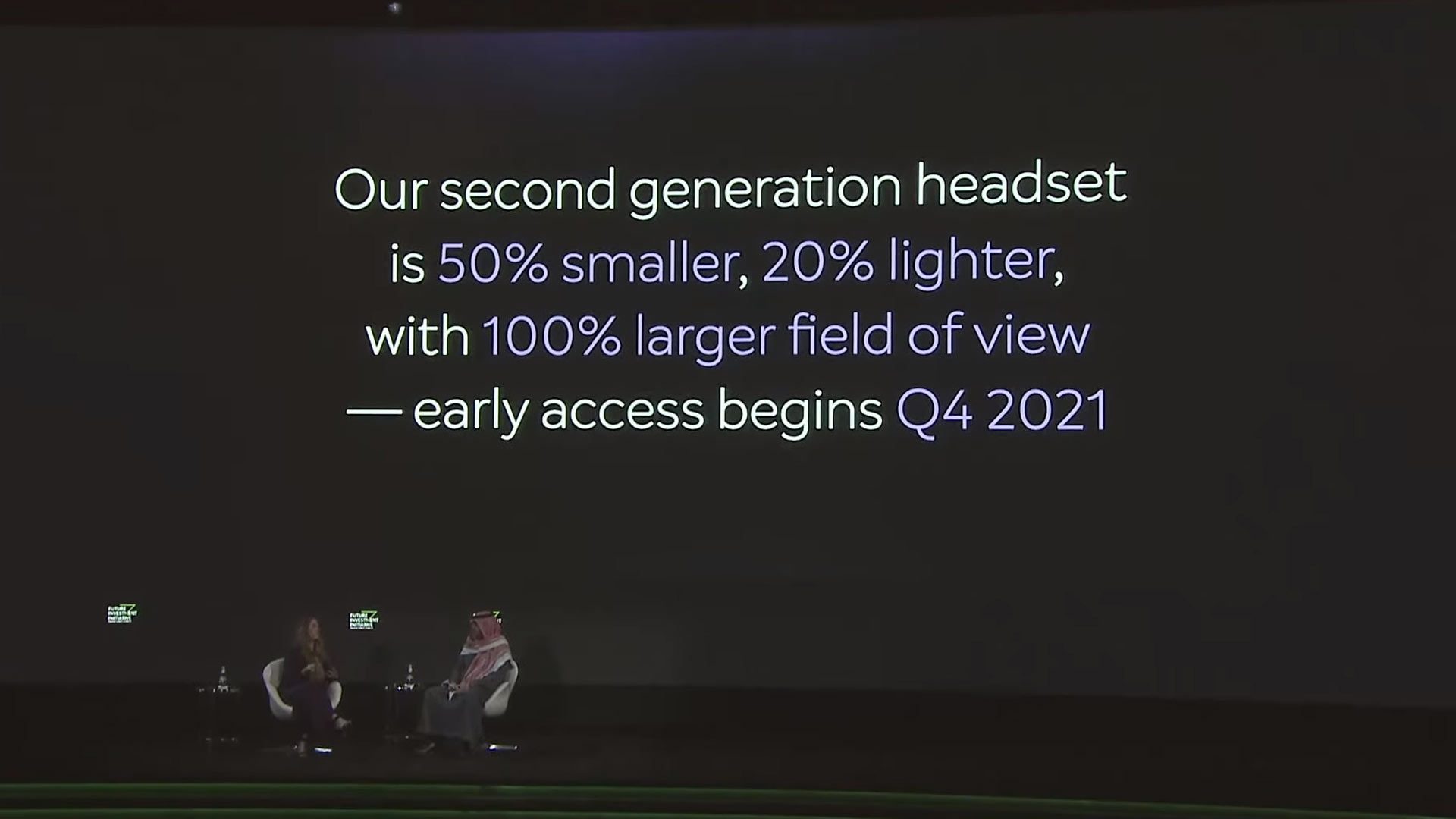
Johnson didn’t speak directly about the company’s next headset on stage at FII, however a slide was shown promising a Q4 2021 window for early access release.

There’s little else to go on for now, however the company says its second-gen headset will be “50% smaller, 20% lighter, with 100% larger field of view.”

Image courtesy FII Institute

Looking at the first-gen Magic Leap headset itself, and not taking into account the compute unit, the 2018 version weighs 316 g, which would make the second-gen device approximately 250 g.

As for FOV, Magic Leap 1 features a 4:3 aspect ratio, and an estimated horizontal FOV of 40 degrees, a vertical FOV of 30 degrees, and a FOV diagonal of 50 degrees. There’s no telling what aspect ratio the next Magic Leap headset will feature, or how the company will effectively market its “100% larger” FOV moving forward; the company only quotes the diagonal FOV of 50 degrees in marketing material.

Here, it’s very likely the company is talking about a 100 percent increase of overall surface area, and not a 100 percent increase of a single spec (re: not going from 40 to 80 horizontal FOV). That would give it around a 55 degree horizontal FOV.

Note: To increase the specs of all provided FOVs by 100 percent, the surface area would need to increase by four times, which is a tall order.

This comes as a modest upgrade, but one that businesses can probably get behind if it’s delivered at a competitive price point comparative to Microsoft’s HoloLens 2, its largest competitor in the field of enterprise-focused AR headsets. Since Magic Leap’s pivot to enterprise last year, the company has been serving mostly the same clientele, which includes industrial applications, medicine, education, and manufacturing.

The post Magic Leap’s Next AR Headset to Ship in Q4 2021, Promising Larger FOV & More Compact Design appeared first on Road to VR.


Ream more: https://www.roadtovr.com/magic-leap-2-release-date-specs/

At $600K, Tundra Tracker Smashes Kickstarter Goal in Less Than 24 Hours

Tundra Tracker, the SteamVR Tracking tracker in development by Tundra Labs, has well exceeded its $250,000 Kickstarter goal in less than 2...