Friday, January 29, 2021
VR Stats Show Huge Growth & Valve's New VR Headset Will Be Crazy! - Update VRiday #1
First Update VRiday of the year! We'll talk about: VR growth of the past year (it's exciting), a new project by Valve that is very NerveGear-like, and so much more XR news! Thanks to Antlion Audio for sponsoring today's video. ► Get 15% off your ModMic right here → https://thld.co/antlionaudio_casandchary Since it's the first episode of 2021, I wanted to do a VR year in review, for which I’ve collected statistics from our industry, and they’re actually really exciting. We may be very close to going mainstream! I'll also talk about the latest VR news and highlights of the last few weeks including Valve's new project will remind you of the SAO NerveGear, we are getting Ready Player One like experiences and new VR headsets. ----------------------------------------------------------------------------------- LINKS Some of the links below may be affiliate links. From those, we earn a small referral fee from qualifying purchases that help support the channel. However, it doesn't cost you more. ► Upgrade your audio now! Go to https://antlionaudio.com/casandchary and use the promo code CASANDCHARY at checkout to get 15% off. ► Oculus Multi-user Accounts & App sharing: https://developer.oculus.com/blog/multi-user-accounts-and-app-sharing-coming-soon/ ► SideSketch on SideQuest: https://sidequestvr.com/app/2852/sidesketch ----------------------------------------------------------------------------------- TIMESTAMPS 00:00 Intro O.O 02:16 VR Growth Statistics! Year In Review 2020 04:44 VR In The Following Years? When Mainstream? 05:51 Valve's "NerveGear" Brain-Computer Interface (BCI) 07:23 HaptX New Crazy Gloves 07:51 Apple's Standalone VR Headset 08:17 Canon's MR Headset: MREAL S1 08:40 UNAI Social VR Headset 09:30 Oculus' Expectations VS Reality 10:05 Oculus Multi-user Accounts & App sharing 10:54 Tilt Brush Now Open-Source 11:30 Quick VR Game News 12:58 Two Exciting Upcoming Games 13:53 Question Of The Day & Outro Start ----------------------------------------------------------------------------------- SUPPORT THE CONTENT (and become our VR Champion) ► Become our Patron → http://bit.ly/PatreonCasandChary ► Become a Sponsor on YouTube → http://bit.ly/JoinCasandChary ► Buy our VR Merch → http://bit.ly/casandchary-merch VR DISCOUNT CODES & AFFILIATE LINKS ► ► https://casandchary.com/discount-codes-affiliate-links/ ----------------------------------------------------------------------------------- OUR GEAR Our VR Equipment & Tips → https://www.amazon.com/shop/caschary (affiliate link) Our PC Specs → https://casandchary.com/vr-equipment/ MUSIC Music we use is from Epidemic Sounds → http://bit.ly/CCEpidemicSound ----------------------------------------------------------------------------------- GET LATEST UPDATES Twitter → https://twitter.com/CasandChary Facebook → https://www.facebook.com/casandchary/ Instagram → https://www.instagram.com/casandchary/ Join our Discord → https://discord.gg/YH52W2k ----------------------------------------------------------------------------------- A SPECIAL THANKS to these Patreon Champs 🛡️ for their support: 😘 BaxornVR, Wintceas, Studioform VR, Barr'd4Life, Andy, Albert, Ben P., Steve Dunlap, Thomas M. Rice, Andy Fidel, VR Balance, Nathan S., Adriaan K. ----------------------------------------------------------------------------------- DISCLAIMER This video was sponsored by Antlion Audio. Per our guidelines, no review direction was received. Our opinions are our own. Links in this description may contain affiliate links. We may earn a small referral fee from qualifying purchases that helps supports the channel. However, it doesn't cost you more. #vrnews #vr #casandchary VR on! - Cas and Chary VR

‘Tilt Brush’ Derivative Apps Come to PC VR & Quest Mere Hours After Google Open Sources

Google’s VR art creation app Tilt Brush isn’t free, but the company made it open source a few days ago after announcing it has stopped active development, so it was only a matter of time before independent developers got under the hood to publish their own Tilt Brush-derived apps. Now you can play around with the first batch on PC VR and Oculus Quest.
Open Brush – PC VR
Developer Icosa Gallery has published its own fork of the Tilt Brush software, dubbed Open Brush. Although there’s a few missing features for now, notably the ability to use the eraser, Open Brush is already enabling some of the hidden brushes that Google never released before shelving the project.
You can download the experimental build of Open Brush over at Itch.io for free, and get painting through SteamVR-compatible headsets right now.
Icosa Gallery says there’s also a Quest version in the works, however it’s not ready just yet.
SideSketch – Quest
If you own an Oculus Quest or Quest 2, you can also test out the latest third-party clone from developer Shane Harris, called SideSketch.

For now it appears to be a direct clone without any added features, albeit free of charge. Like Open Brush on PC, SideSketch is missing the eraser function.
To get SideSketch, you’ll need to set up SideQuest on your Quest headset, the unofficial app store for all things Quest. Check out our simple guide of how (and why) to use SideQuest to get up and running with SideSketch and a plethora of free and paid apps.
Tilt Brush for WebXR
The amazing thing about WebXR is that all you need is a URL, a compatible web browser and a PC VR or Quest headset to start playing and connecting in virtual spaces.
WebXR applications are notably smaller than apps that require a direct download and installation, and it seems a WebXR Tilt Brush derivative from developer Douglas Adams of msub2, called Silk Brush, is still brewing as a result.
First drawing with the WebXR port of Tilt Brush, from here on out known as Silk Brush! #TiltBrush #SilkBrush #WebXR pic.twitter.com/Px3ZZIrj9z
— m₂ (@msub2official) January 29, 2021
At the moment, Adams says its still only capable of basic drawing, as he’s still working on integrating the wand’s complete set of functions—not a simple task since it needs to be light enough to run in-browser.
Seeing Tilt Brush as a potential WebXR application is really exciting though. Not only will users be able to pop in and create things quickly, but the hypothetical addition of multiplayer could make it a great place to quickly connect with others for everything from product ideation to collaborative art. Adams hasn’t mentioned that bit yet, although it was buried in the code as a ‘to-do’ by Google before they stopped active development.
Know of any apps making use of Tilt Brush code? Let us know in the comments below!
The post ‘Tilt Brush’ Derivative Apps Come to PC VR & Quest Mere Hours After Google Open Sources appeared first on Road to VR.
Ream more: https://www.roadtovr.com/tilt-brush-open-source-pc-vr-quest-2-webxr/
Ultraleap’s New ‘Gemini’ Software Overhaul Drastically Improves Two-handed Interactions

Ultraleap, the company behind the Leap Motion hand-tracking controller, has released a Developer Preview of its hand-tracking engine Gemini. By many accounts, Ultraleap’s latest software overhaul dramatically increases the ability of the company’s camera modules to do more precise and stable two-handed interactions.
Gemini is now available in Developer Preview for Windows 10, and is designed to work with all existent Leap Motion controllers as well as Ultraleap’s more recent Stereo IR 170 camera module.
In comparison to Orion (V4), which was released in June 2018, its Gemini (V5) engine is said to offer better smoothness, pose fidelity, and robustness. It also improves hand initialization, and brings “significantly better performance with two-hand interactions,” Ultraleap says.
As seen in the gif below, the solidity of Gemini (V5) is pretty astounding. Not only are both hands more accurately tracked, but occlusion appears to be much less of an issue too, as fingers interlock and move in front of each other with comparative ease.
Ultraleap is set to integrate Gemini into a number of XR headsets, including Varjo VR-3 and XR-3 headsets, and the Qualcomm Snapdragon XR2 5G reference design, which makes use of Ultraleap hardware.
Antony Vitillo of XR publication Skarred Ghost went hands-on with Gemini using his first-generation Leap Motion tracker. To him, the software overhaul represents “the best hands-tracking system I’ve seen until now on all headsets for what concerns the interactions between two hands.”
“What really surprised me is the stability of two hands interactions. For the first time, I’ve been able to make the fingers of my two hands cross and interweave [together], and the tracking kept working reliably.”
Granted, Vitillo’s five year-old Leap Motion does present somewhat of a roadblock due to its comparatively small field of view, however Ultraleap says with its updated IR 170 camera module that “hands will almost certainly be tracked before they come into your sight.”
In practice, Ultraleap hopes its new software will let developers create hand-tracking-focused applications in preparation for the next wave of AR and VR headsets to make more prominent use of the technology. Facebook’s Oculus Quest standalone notably includes hand-tracking for use within its system UI and a handful of applications, however it hasn’t become a standard input method yet.
The post Ultraleap’s New ‘Gemini’ Software Overhaul Drastically Improves Two-handed Interactions appeared first on Road to VR.
Ream more: https://www.roadtovr.com/ultraleap-v5-gemini-developer-preview/
Thursday, January 28, 2021
Total Quest Games Reviews Have Exceed Oculus PC Reviews in Less Than Two Years
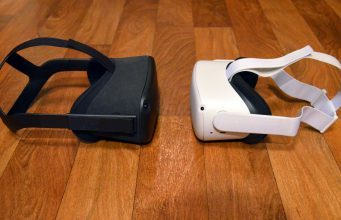
Adding to a growing number of data points showing why Facebook has shifted its attention away from Oculus PC is the difference in momentum between the two platforms as revealed by game review counts over time. This month, the number of reviews across all Quest games has exceeded the number of reviews across all Oculus PC games.
The number of times a game has been reviewed generally correlates with how many units that game has sold. Thus, looking at the count of all reviews in a given game marketplace over time can give us some indication of the trend of unit sales in that marketplace.
Worth noting: when it comes to Quest, users are required to install the Oculus smartphone app, which has a variety of mechanisms to pull users back into the app—like scoreboard and challenge prompts—where they can also write a review for games in their library. On the other hand, the Oculus PC app doesn’t have much of that functionality, nor is it always in your pocket.
So, all things equal, we’d expect from the outset that a larger proportion of Quest users would write reviews compared to Oculus PC users. Exactly how many more, however, is hard to figure. So while it’s interesting to see that this month the total number of Quest game reviews surpassed the total number of Oculus PC game reviews, as we can see below, it isn’t the count that’s particularly interesting, but the trend.
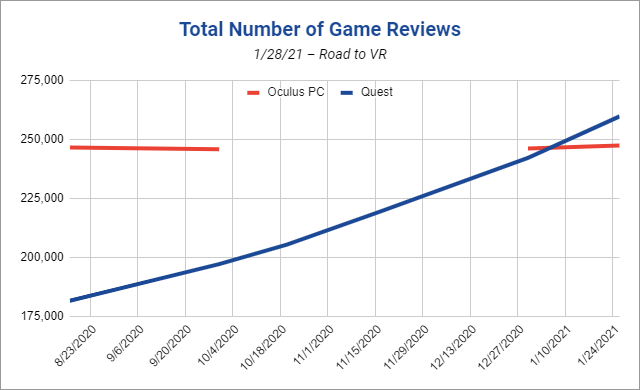 The first Quest launched in May of 2019, which was when the Quest store first went online. It took a little less than two years (from May 2019 to January 2021) for Quest game reviews to surpass the number of Oculus PC game reviews.
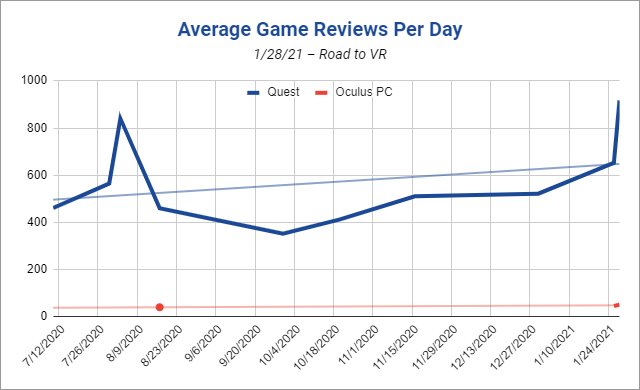
Another way to look at this is to look at the average number of reviews per day. Here we can see that not only the count, but more importantly the trend is moving healthily upward on Quest, whereas the Oculus PC store has largely flatlined in comparison.
 Another interesting point to note is that the number of Quest game reviews is spread across a much smaller number of games. The Quest store has just 253 games, while the Oculus PC store has some 1,800. This is no doubt due to Facebook’s decision to “curate” the Quest store.
Despite the large quantity of games on the Oculus PC store, only 339 (19%) have reached the seemingly low bar of 100 or more reviews. The median number of reviews for each game on the store is 240.
Quest games are much more consistently surpassing 100 reviews, with 201 (79%) crossing the threshold. The median number of reviews for each game on the Quest store is 621.
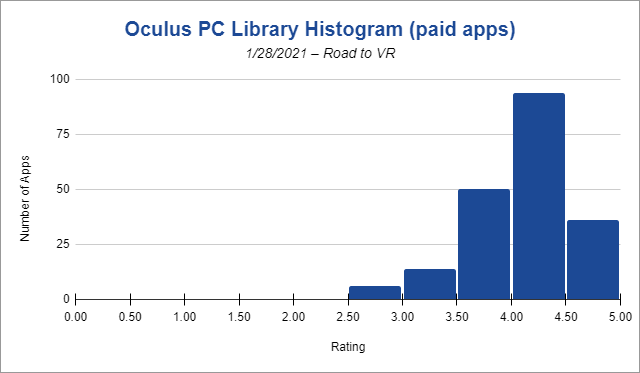
Value—as revealed through user reviews—is another interesting point of comparison between the two stores. Below we can see that the rating distribution leans significantly higher on the Quest store vs. Oculus PC.

And a final note worth pointing out: while this data suggests that the Oculus PC store is stagnating, we can’t necessarily extend this conclusion to the overall PC VR category, where Steam is one of PC VR’s largest marketplaces (and is not represented in this data). On that front, Valve shared some positive figures about VR usage on Steam in 2020, and other data suggests the platforms continues to grow.
The post Total Quest Games Reviews Have Exceed Oculus PC Reviews in Less Than Two Years appeared first on Road to VR.
Ream more: https://www.roadtovr.com/total-quest-game-reviews-exceed-oculus-pc/
‘Wraith: The Oblivion – Afterlife’ to Release in Spring 2021, More Gameplay Revealed

Fast Travel Games, the studio behind Apex Construct (2018) and Budget Cuts 2 (2019), are bringing their ‘World of Darkness’ horror game Wraith: The Oblivion – Afterlife to all major VR platforms this spring. Now the studio has served up a fresh gameplay video featuring the mysterious ‘Shadow’ who guides you.
Update (January 28th, 2021): Fast Travel Games released a new video (linked above and below the article) that shoes off the game’s mysterious ‘Shadow’ character. Here’s how the studio describes it.
“As a Wraith in Afterlife, you will have a companion of sorts by your side called ‘the Shadow’. The Shadow is a manifestation of your dark subconscious – call it the devil on the shoulder, or the little voice in the back of your head telling you to do the things you really shouldn’t. So, while he functions as a guide through the game… should you really trust him?”
Now the studio says it is targeting spring 2021, which may still fit within its ‘Early 2021’ launch window.
Update (December 17th, 2020): Fast Travel Games published some new gameplay footage today, showing off the level of polish coming to Quest 2 and further detailing some of the game’s mechanics.
Wraith: The Oblivion – Afterlife is set launch sometime in early 2021 on all the major VR headsets, which includes SteamVR, the Oculus Store for Quest and Rift (supporting cross-buy), and PlayStation VR.
We’ve time-linked the video below where Quest 2 footage is highlighted. Developer Andreas Juliusson also speaks a bit about what to expect, including special powers, the game’s World of Darkness setting, and the mystery of why and how you’ve become a ghostly apparition.
Original Article (June 9th, 2020): Fans of the World of Darkness universe and its many tabletop role-playing games are no doubt familiar with Vampire: The Masquerade and Werewolf: The Apocalypse.
Wraith: The Oblivion – Afterlife is said to follow in the footsteps of its 1994-era tabletop RPG namesake by placing you in the modern Barclay Mansion and putting you in the ghostly shoes of a Wraith who unravels the mysteries “that await beyond the Shroud.”
Erik Odeldahl, Creative Director at Fast Travel Games, says that horror games such as Amnesia: The Dark Descent and Alien: Isolation have influenced the studio to create a similar “narrative-driven, exploration-focused” horror title in the World of Darkness universe.
The game, which doesn’t have a release date yet, is slated to arrive on “all major VR platforms,” Fast Travel says.
A gameplay reveal and details are said to arrive during Gamescom Now, which starts August 27th. Hopefully we’ll be getting a release date then too.
The post ‘Wraith: The Oblivion – Afterlife’ to Release in Spring 2021, More Gameplay Revealed appeared first on Road to VR.
Ream more: https://www.roadtovr.com/world-darkness-horror-game-vr-afterlife/
Magic Leap Founder Rony Abovitz Unveils New Startup to Build Virtual Humans

Rony Abovitz, founder of Magic Leap, is starting on a new path after his departure as CEO of the well-funded augmented reality company last year. Abovitz just unveiled his next project, a startup called Sun and Thunder, which aims to build what he calls “synthetic beings.”
Founded late last year, Abovitz says the company’s first project will feature a character named Jako Vega, also known as ‘Yellow Dove’, which will be the center of a number of short film experiments set to release sometime in 2021.
On the face of it, Sun and Thunder feels patently Abovitzian in its near-science fiction ambitions to create digital life. Much like Magic Leap’s AI-driven virtual companion Mica, which was billed as an “educator, agitator, companion, artist and guide,” Abovitz imbues Yellow Dove with a degree of sentience that’s fairly questionable—at least for now.

The startup says on its website that Yellow Dove is “a member of the Sun and Thunder team, a co-creator, and traveler through a number of interconnected Sun and Thunder storyworlds. He is a musician and the first artist on Sun and Thunder Records.”
Abovitz tells Venture Beat in an exclusive interview that the upcoming short film will act as an introduction to the Yellow Dove character.
“He goes outside and teaches us about the world, and we’re building out the underlying technology that makes these things happen. It’s a small enough container that we are developing. And he ultimately will be writing all of his lyrics and adventures.”
Continuing, Abovitz says the startup isn’t trying to “take on like the largest tech companies in the world,” à la Magic Leap. “It’s not the best metaphor, but this is like a craft beer. Or something Studio Ghibli would do.”
Abovitz tells Venture Beat that Sun and Thunder is being funded out of pocket for now, although he’s currently in talks with potential investors. Abovitz still sits on Magic Leap’s board of directors, however Sun and Thunder is a separate venture that isn’t tied to a specific platform.
The post Magic Leap Founder Rony Abovitz Unveils New Startup to Build Virtual Humans appeared first on Road to VR.
Ream more: https://www.roadtovr.com/magic-leap-rony-abovitz-sun-thunder-virtual-humans/
Wednesday, January 27, 2021
HaptX Launches New & Improved DK2 Haptic VR Gloves for Enterprise
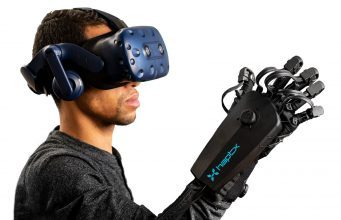
HaptX, the company building high-end haptic VR gloves for enterprises, launched its latest model, DK2, which is now available for purchase. The new version is said to have improved haptics, force-feedback, size, comfort, and manufacturability.
HaptX builds VR gloves which include finger tracking, skin-displacement haptics, and force-feedback. As far as VR gloves go, they’re the most convincingly immersive I’ve used yet.
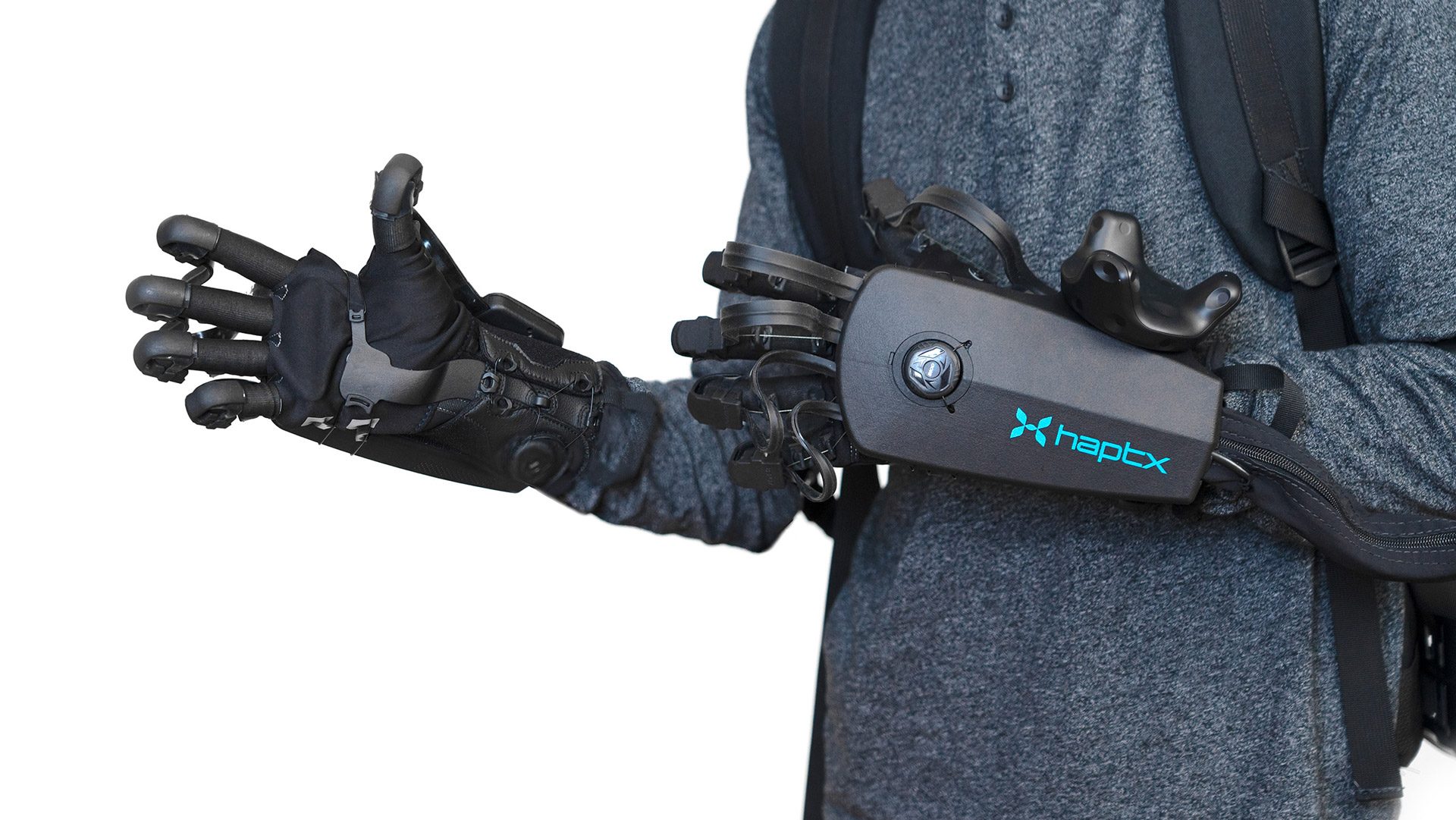
Previously, HaptX was only able to loan evaluation units of its gloves to interested parties, because the company was “severely limited in the number of units we could manufacture,” says CEO Jake Rubin. With the newly announced DK2 model, the company says it has streamlined the design which has enabled it to manufacture enough of the gloves to sell them outright.
“[Our manufacturing capacity was limited] due to a combination of the high complexity of our system, the number of novel components and production processes involved, and our limited manufacturing experience as a startup. Our manufacturing challenges were one of the primary catalysts behind our comprehensive partnership with Advanced Input Systems,” says Rubin “[…] we have been able to radically streamline manufacturing of the system. This has enabled us to finally satisfy the demand we’ve generated with our DK1 and earlier prototype systems by allowing customers to purchase DK2 outright and begin deploying HaptX technology at scale within their organizations.”
Part of that streamlining process also means slimming the system down. The Air Controller unit, which powers the pneumatic-based haptics in the gloves, once weighed 180 pounds. While the gloves are far from compact, with HaptX DK2 the company has reduced the system’s overall size enough to be able to mount the Air Controller on the user’s back. “We do expect that many, if not most, of our customers will use the system in room-scale [backpack] mode given the enhanced immersion and mobility,” Rubin says.
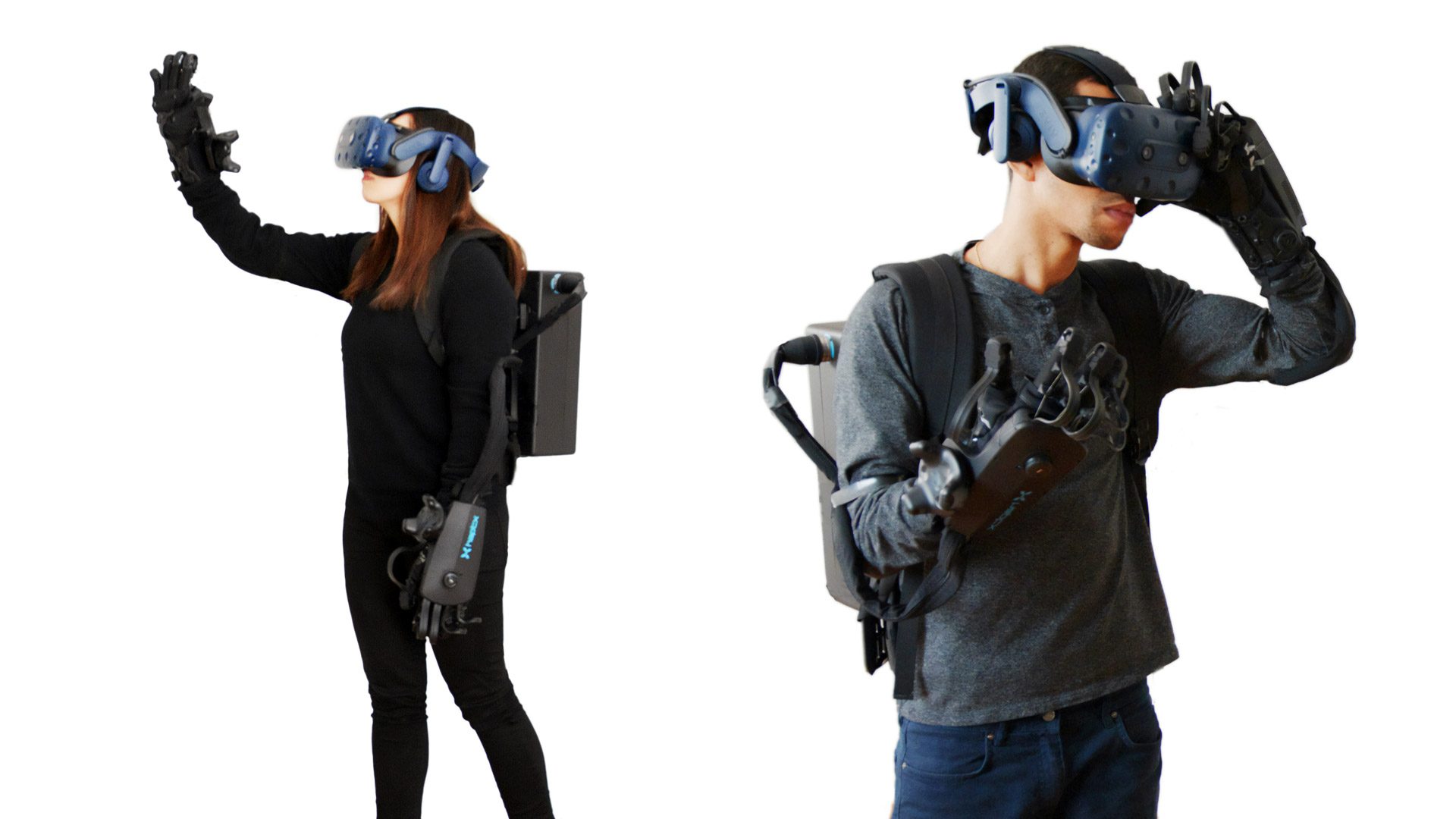
Unfortunately the backpack unit doesn’t include the computer hardware necessary for the VR headset itself, so users will still need to be tethered to a PC or use a wireless solution.
Beyond the smaller Air Controller and improved manufacturing, Rubin says the DK2 has a handful of other improvements.
The force-feedback system can now apply up to 40 pounds of resistance per hand, and also has better stiffness and lower latency. The finger-tracking hardware in the gloves has also been massively shrunk down from two external boxes to a small board which is built directly into the gloves. Further, Rubin says, the gloves have improved fit and ergonomics, and are easier to put on and take off.
With these improvements, HaptX is now selling their gloves directly to enterprise customers. Though an official price hasn’t been announced, we understand the cost to be in the tens of thousands of dollars per unit.
That huge price tag puts the HaptX DK2 gloves in the high-end of the already expensive enterprise-focused VR sector, among the likes of Varjo’s enterprise headsets. While the company surely expects to further slim its gloves down in both size and price, if there’s buyers out there today we’d expect to find them in massive industries like military, medical, automotive, et al.
The post HaptX Launches New & Improved DK2 Haptic VR Gloves for Enterprise appeared first on Road to VR.
Ream more: https://www.roadtovr.com/haptx-dk2-vr-glove-launch/
Subscribe to:
Posts (Atom)
At $600K, Tundra Tracker Smashes Kickstarter Goal in Less Than 24 Hours
Tundra Tracker, the SteamVR Tracking tracker in development by Tundra Labs, has well exceeded its $250,000 Kickstarter goal in less than 2...
-
Please hit that subscribe button it honestly makes my day! Want to buy me a beer? https://streamlabs.com/theukrifter Want to chat VR? - J...
-
In Dreams, you can create your own worlds or play those of others, and there are some INCREDIBLE worlds out there. VR mode was just relea...

