Solaris Offworld Combat (2020), the team-based VR arena shooter for Oculus Rift and Oculus Quest, is getting an update this week that’s set to bring a number of highly requested features to the game, including the long-awaited ability to squad up with friends.
In addition to the ability to create a squad, the studio is packaging a few features in the update too, which include:
New Map: Fury Major – redesigned to focus on more centralized player engagement and close quarters combat
Stamina Cooldown Changes: enjoy unlimited sprinting with a cooldown that happens only if you spam slide
IRL Crouch To Slide
Daily XP Bonus & Weekly Challenges
Free Hand Tracking: you can now move both arms independently while playing, this will not affect your weapons accuracy
Gameplay Balancing
Bug Fixes & General Improvements
There’s no precise timing on release of the update, however developers First Contact Entertainment say it should be here sometime this week.
Fury Major Map, Image courtesy First Contact Entertainment
In our preview of Solaris Offworld Combat, we liked the fast-paced experience designed for anyone can pick up and play, although it was still a bit rough around the edges. Some of those items we noted in the preview are being featured in the squad update, namely the lack of controller tracking for non-dominant hands. It’ll also be interesting to see whether the update can better balance its casual and competitive ambitions.
Solaris Offworld Combat includes cross-play and cross-buy between the Rift version and Quest version, priced at $30. The game is expected to also land on Steam and PSVR at some point, although it’s still unclear when. In the meantime, check out some of out preview gameplay footage below to get and idea of what Solaris has to offer.
MARVEL Powers United VR (2018) and other Oculus Rift exclusives developed by Sanzaru Games are officially going offline next March.
Marvel Powers United VR, Ripcoil (2016), and VR Sports Challenge (2016) are no longer available for purchase or download, however Oculus says current owners can continue playing through March 1st, 2021.
After that date, the company tells Road to VR that it’s making the entirety of Marvel Powers United VR and Ripcoil inaccessible, which also includes any single-player content. Oculus suggests uninstalling the games afterwards “to avoid dead space taken up on your device.” It’s uncertain if the same is true for VR Sports Challenge, as it’s a single-player collection of minigames with no online play component.
If you purchased any of those games, it’s important to note that refunds are not automatic. Users need to reach out to Oculus Customer Support to specifically request a refund for the games.
Marvel Powers United VR was no doubt one of the most expensive games to secure as a Rift exclusive—it was featured in the original Rift’s first retail bundle back in 2018—so the decision to take it offline and refund its users couldn’t have been an easy one to make. Considering how the game was rated at launch though, having received middling scores across Metacritic and the Oculus Store itself, it seems the game suffered from the same ailment as all mediocre online VR games, namely inconsistent concurrent user numbers. You could chalk it up to its overall gameplay loop; it was essentially just a super hero-flavored wave shooter.
And like a self-fulfilling prophecy, when user numbers are consistently low, people tend to not stick around for long before writing off a game entirely. It’s notoriously tough to lure players back once the damage is done and initial opinions are formed, even after multiple updates and rebalances.
Ripcoil was one of Sanzaru’s first VR games, arriving alongside VR Sports Challenge (2016) for the launch of Oculus Touch back in December 2016. Ripcoil is a futuristic VR sports game that is a bit like Pong, albeit it in the first person. It’s been long criticized in user reviews as being essentially dead though, and also features a questionably uncomfortable sliding locomotion scheme which may have turned off a good percentage of players from the get-go.
It also appears that VR Sports Challenge was removed from direct store access too, although since it’s a single-player game with no online component, it’s possible existing users may be able to play after the March 1st cutoff date.
In any case, it seems Facebook is cleaning house somewhat following the company’s decision to sunset the Rift hardware platform entirely. Sanzaru Games was acquired by Facebook earlier this year, so purging underperforming first-party Rift content may simply be a cost-savings measure moving forward to a near future dominated by the company’s second standalone headset, Oculus Quest 2.
Last Wednesday, I proposed to Chary. You may have seen our social media posts about it. But what I didn’t tell people then is that I actually learned to make a VR game for this occasion. And it was everything I wanted it to be. ► Our VR equipment kit & tips here → https://www.amazon.com/shop/caschary (affiliate) ► Subscribe here → https://goo.gl/bSJ6L8 Chary and I have been together for 6.5 years, and more than half of those years have been with you, this channel. And so we wanted to share this story with you too, as this channel has affected our lives in the most positive way, and we appreciate that. So we hope you enjoy this not-so-usual video from us where I share with you what I did, how we got there, and then me... on my knees. ----------------------------------------------------------------------------------- LINKS ► Tevfik's Oculus Quest 1 & 2 courses: - https://www.udemy.com/course/oculus-quest-development-with-unity/?couponCode=CYBR_MNDP - https://www.udemy.com/course/multiplayer-virtual-reality-vr-development-with-unity/?couponCode=CYBR_MNDYP ► Get an Oculus Quest 2 (US) → http://bit.ly/quest2-casvr (affiliate) ► Get an Oculus Quest 2 (NL - Coolblue) → https://cb.prf.hn/l/784dkp8 (affiliate) ► Get on Amazon → https://amzn.to/2RSxaDi (affiliate) * Some are affiliate links we may earn from qualifying purchases. ----------------------------------------------------------------------------------- TIMESTAMPS 00:00 Intro Start - What's In This Video 02:39 The Proposal + Our Reaction 11:58 Outro Start ----------------------------------------------------------------------------------- SUPPORT THE CONTENT (and become our VR Champion) ► Become our Patron → http://bit.ly/PatreonCasandChary ► Become a Sponsor on YouTube → http://bit.ly/JoinCasandChary ► Buy our VR Merch → http://bit.ly/casandchary-merch VR DISCOUNT CODES & AFFILIATE LINKS ► ► https://casandchary.com/discount-codes-affiliate-links/ ----------------------------------------------------------------------------------- OUR GEAR Our VR Equipment & Tips → https://www.amazon.com/shop/caschary (affiliate) Our PC Specs → https://casandchary.com/vr-equipment/ MUSIC Music we use is from Epidemic Sounds → http://bit.ly/CCEpidemicSound ----------------------------------------------------------------------------------- GET LATEST UPDATES Twitter → https://twitter.com/CasandChary Facebook → https://www.facebook.com/casandchary/ Instagram → https://www.instagram.com/casandchary/ Join our Discord → https://discord.gg/YH52W2k ----------------------------------------------------------------------------------- A SPECIAL THANKS to these Patreon Champs 🛡️ for their support: 😘 BaxornVR, Wintceas, Studioform VR, Barr'd4Life, Andy, Albert, Ben P., Steve Dunlap, Thomas M. Rice, Andy Fidel, VR Balance, Nathan Schmidt ----------------------------------------------------------------------------------- DISCLAIMER Links in this description may contain affiliate links. We may earn from qualifying purchases (it doesn't cost you more). #proposal #casandchary #girlfriendtag VR on! - Cas and Chary VR
Switzerland-based CREAL is developing a light-field display which it hopes to bring to VR headsets and eventually AR glasses. In November the company raised CHF 6.5 million (~$7.2 million) in a Series A+ investment round to bring on new hires and continue miniaturizing the company’s light-field tech.
Creal says it closed its Series A+ investment round in mid-November, raising CHF 6.5 million (~$7.2 million) led by Swisscom Ventures with participation by existing investors Investiere, DAA Capital Partners, and Ariel Luedi. The new funding marks ~$15.5 million raised by the company thus far.
Over the last few years we’ve seen Creal make progress in shrinking its novel light-field display with the hopes of fitting it into AR glasses. Compared to the displays used in VR and AR headsets today, light-field displays generate an image that accurately represents how we see the real world. Specifically, light-field displays support both vergence and accommodation, the two focus mechanisms of the human visual system. Creal and others say the advantage of such displays is more realistic and more comfortable visuals for VR and AR headsets. For more on light-fields, see our explainer below.
Light-fields are significant to AR and VR because they’re a genuine representation of how light exists in the real world, and how we perceive it. Unfortunately they’re difficult to capture or generate, and arguably even harder to display.
Every AR and VR headset on the market today uses some tricks to try to make our eyes interpret what we’re seeing as if it’s actually there in front of us. Most headsets are using basic stereoscopy and that’s about it—the 3D effect gives a sense of depth to what’s otherwise a scene projected onto a flat plane at a fixed focal length.
Such headsets support vergence (the movement of both eyes to fuse two images into one image with depth), but not accommodation (the dynamic focus of each individual eye). That means that while your eyes are constantly changing their vergence, the accommodation is stuck in one place. Normally these two eye functions work unconsciously in sync, hence the so-called ‘vergence-accommodation conflict’ when they don’t.
On more advanced headsets, ‘varifocal’ approaches dynamically shift the focal length based on where you’re looking (with eye-tracking). Magic Leap, for instance, supports two focal lengths and jumps between them as needed. Oculus’ Half Dome prototype does the same, seems to support a larger number of focal lengths. Even so, these varifocal approaches still have some inherent issues that arise because they aren’t actually displaying light-fields.
Through-the-lens: The accurate blur in the background is not generated, it is ‘real’, owed to the physics of light-fields. | Image courtesy CREAL
Creal co-founder Tomas Sluka tells Road to VR that this Summer the company has succeeded in bringing its prototype technology into a head-mounted form-factor with the creation of preliminary AR and VR headset dev kits.
CREAL doesn’t expect to bring its own headset to market, but is instead positioning itself to work with partners and eventually license its technology for use in their headsets. The company aims to build a “complete technology package for the next-generation Augmented Reality (AR) glasses,” which will likely take the form of a reference design for commercialization.
Pimax, the company known for its wide field of view (FOV) VR headsets, have now launched the Pimax “5K” SUPER, a PC VR headset first shown in its prototype stage at CES 2020 earlier this year.
The new Pimax “5K” Super is being billed as a hardware refresh of the Pimax “5K” Plus, which launched in 2018 with 2,560 × 1,440 pixels per-eye LCD display capable of up to 144Hz refresh rate, and a 200-degree FOV. Priced at $600, it’s just one step above the company’s $450 entry-level headset, Pimax Artisan.
Now available for purchase on the company’s website for $750, Pimax “5K” Super features the same 2,560 × 1,440 resolution per-eye and 200-degree FOV as the Plus variant, however the biggest draw is its higher refresh rate at 160Hz, with 180Hz available in experimental mode. In addition to those refresh rates mentioned above, the headset also offers support for 90Hz, 120Hz and 144Hz.
Image courtesy Pimax
Pimax “5K” Super also includes a new Modular Audio Strap, Pimax comfort kit facial padding, nose guard to prevent light leakage, and a ruggedized exterior housing.
As for the headset’s main draw, provided you have the computer to run it, higher panel refresh rates typically equate to smoother experiences: eg. Valve Index’s 144Hz refresh rate offers impressively smooth and tight-feeling gameplay.
Like many of Pimax’s headsets, the “5K” Super is tracked via either SteamVR 1.0 or 2.0 tracking beacons, which must be purchased separately at its base $750 price. A bundle is however available for $1250 which includes two SteamVR 2.0 base stations and two Valve Index controllers.
Pimax headsets are also now said to include the new ‘Pimax VR Experience’ software which the company says “dramatically reduces configuration time for VR software” by automatically applying all VR optimizations required for Pimax headsets and allowing for a one-button launch on any platform.
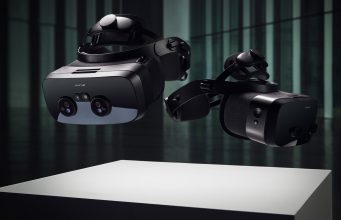
Varjo today announced its latest high-end headsets, the XR-3 and VR-3, with a range of improvements including an expanded field of view, inside-out tracking, and a redesigned headstrap. While still expensive and definitely aimed at large enterprises, the new headsets also get a significant price reduction compared to prior models.
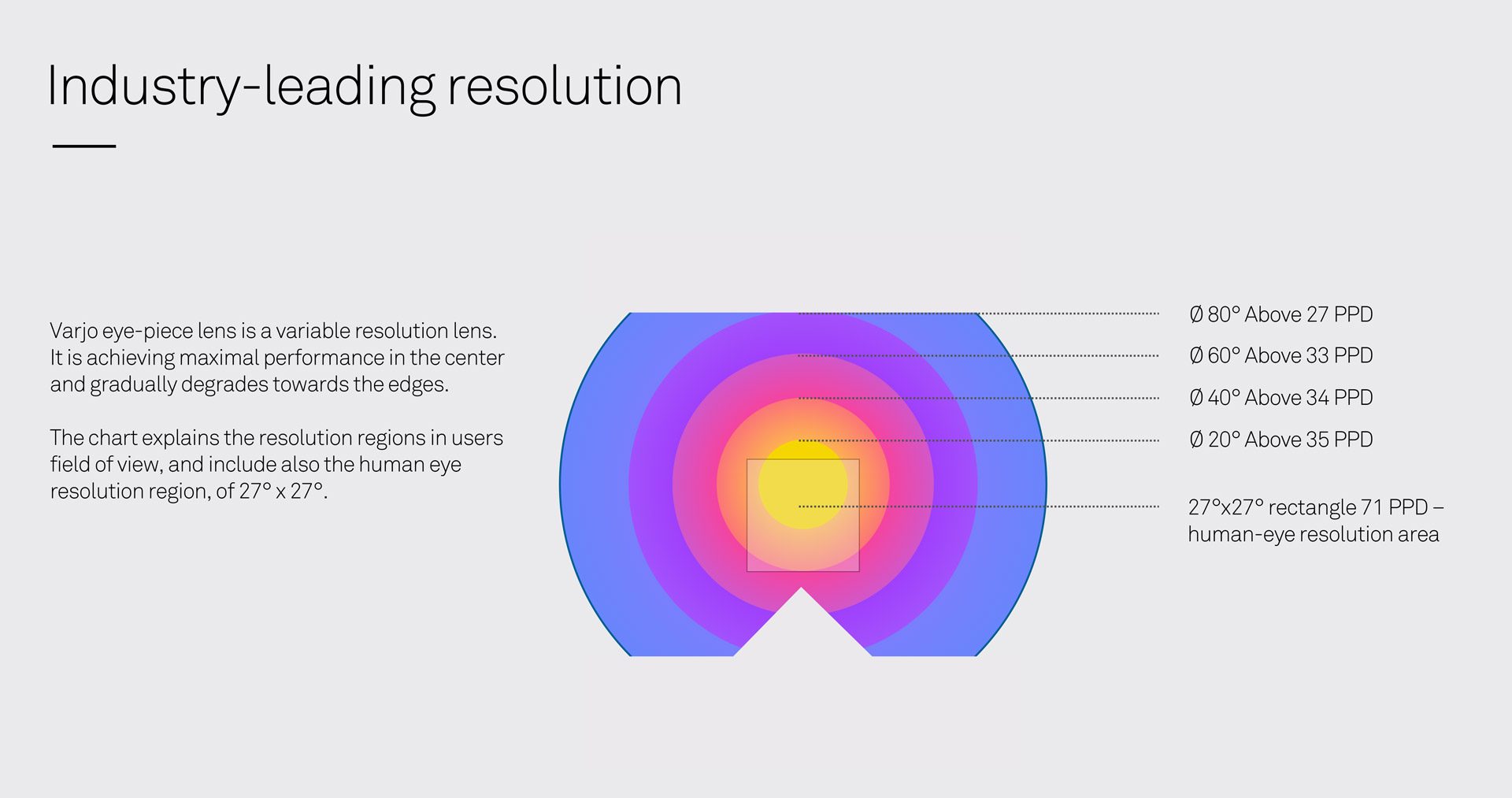
As far as XR headsets go, Varjo’s are quite unique. The company’s headsets use two displays for each eye: a high-density ‘focus’ display at the center, and a larger ‘context’ display to fill out the field of view to immersive levels. The two displays are blended together nearly seamlessly, allowing the very center of the field of view to achieve retina resolution that’s unmatched by any other headset on the market.
The company’s new XR-3 and VR-3 headsets—available for order today and due to start shipping in January—are based on the same concept, but push it further still by expanding the field of view of both the focus display (such that a larger area of the screen is retina resolution) and the context display (for a larger peripheral field of view). At the same time as expanding the field of view, the company has also boosted pixels per-degree across the board.
Boosted Field of View & Resolution
Image courtesy Varjo
Compared to the company’s prior headsets, the XR-3 and VR-3 expand the FoV of the focus display (retina resolution area) from 26° × 16° (30.5° diagonal) to 27° × 27° (38° diagonal). At the same time, the focus display’s resolution is boosted from 62 pixels per-degree to 71 pixels per-degree, offering even finer resolving power (assuming your vision is sharp enough to appreciate it). From a resolution standpoint, the focus display is 1,920 × 1,920 @ 90Hz (compared to 1,920 × 1,080 previously).
As for the context display in the periphery, the field of view is boosted from 87° horizontal on Varjo’s prior headsets to 115° horizontal, the company says. And while the context display hasn’t yet crossed the retina resolution threshold of 60 PPD, it gets its own significant boost from 14 PPD to ~30 PPD. In terms of resolution, that’s an upgrade from 1,440 × 1,600 to 2,880 × 2,720 (both at 90Hz).
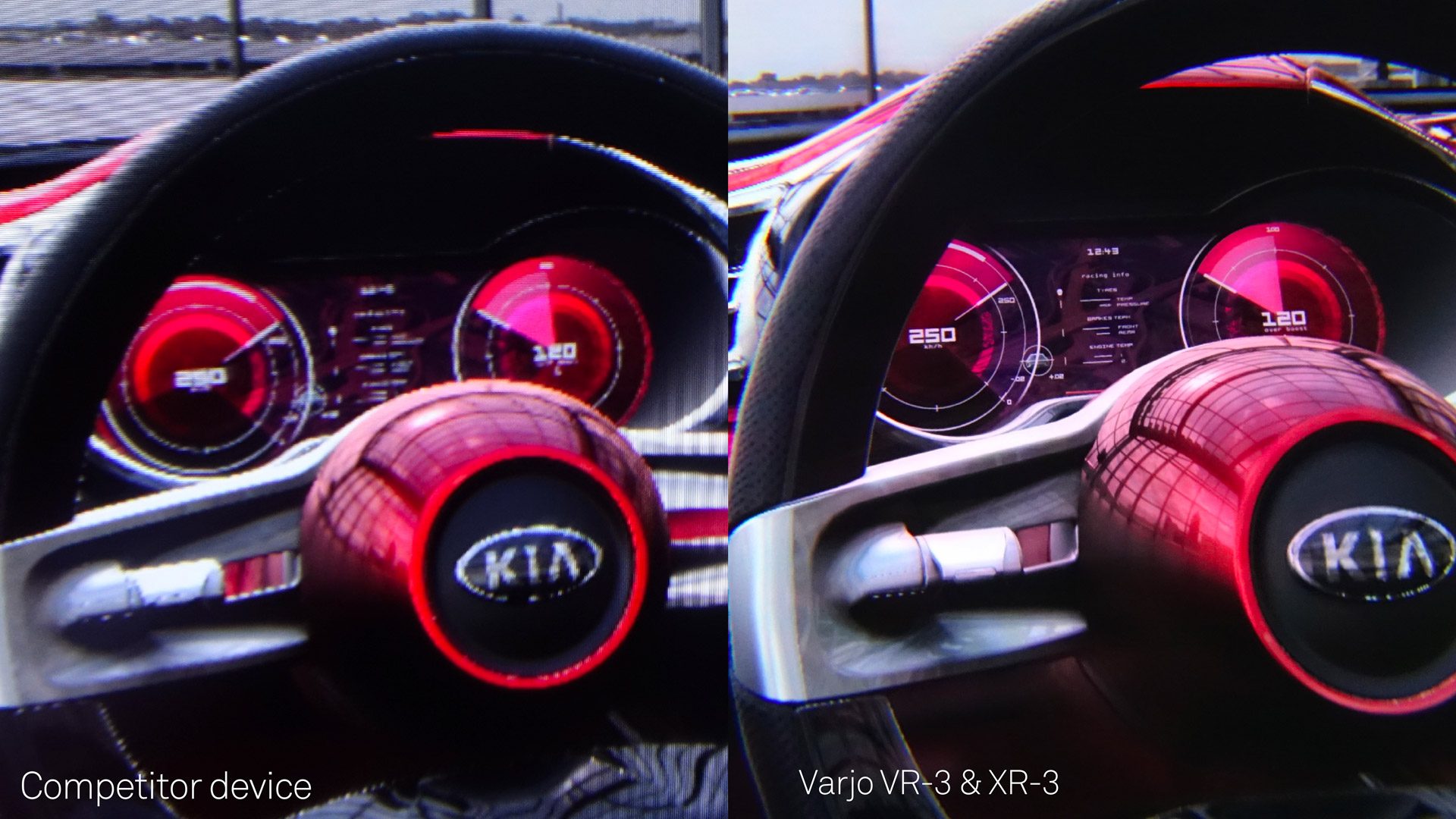
Through-the-lens photo | Image courtesy Varjo
If you haven’t had a chance to look through Varjo’s headsets, it’s difficult to appreciate what all these numbers mean. For a coarse idea of relative resolving power we can consider the megapixels of the displays as compared to consumer headsets:
Headset
Megapixels per-eye
Rift DK1
0.5
Rift DK2
1.0
Rift CV1
1.3
Vive Pro
2.3
Rift S
1.8
Quest
2.3
Index
2.3
Quest 2
3.5
Reverb G2
4.7
Varjo XR-3/VR-3
9.7
That is to say: that’s Varjo’s headsets are far beyond anything in the consumer realm. And of course we’d hope so… given what they cost.
Lower Price (but still pricey)
Image courtesy Varjo
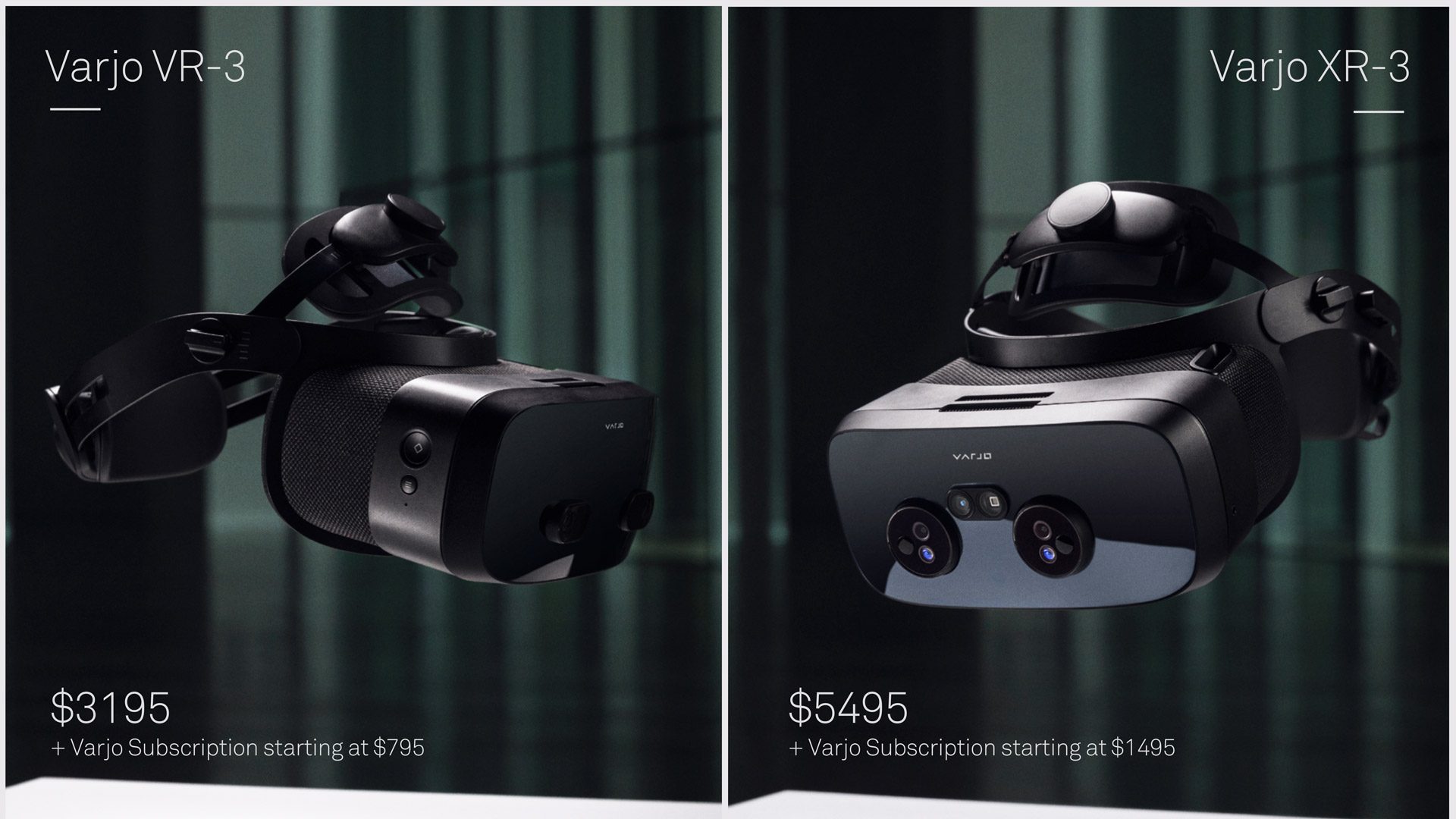
While Varjo’s new headsets aren’t cheap by any means, the company has managed to significantly drop the price despite boosting specs. Here’s the breakdown:
Headset
Varjo VR-2 Pro
Varjo VR-3
Varjo XR-1
Varjo XR-3
Purchase Price
$6,000
$3,200
$10,000
$5,500
Support (annual, required)
$1,000
$800
$1,000
$1,500
Total
$7,000
$4,000
$11,000
$7,000
Both headsets are available for order starting today, with shipments expected to begin in January.
Eye-tracking, Automatic IPD, & More
Image courtesy Varjo
There’s no doubt these headsets are expensive, but Varjo is loading them full of premium features.
Like the company’s prior headsets, the XR-3 and VR-3 both feature 200Hz eye-tracking tech developed in-house, which the company claims is the “world’s fastest and most accurate” integrated eye-tracking solution. Eye-tracking is also used for foveated rendering and automatic IPD adjustment, allowing the bi-convex lenses (not Fresnel) to align themselves with the user’s eyes for optimal clarity and comfort. Both headsets also include hand-tracking from Ultraleap.
XR-3 and VR-3 see a brand new industrial and ergonomic design, reducing weight by 40%, according to Varjo. The new headstrap uses a halo-like design with tightening dials on both the back and top strap.
Both headset’s displays also now boast pro-level color reproduction with 99% sRGB and 93% DCI-P3 color gamut.
Rec Room announced back in September that it was working on a way for its users to earn real cash by creating content for the game. In a recent update, the social VR platform has now taken its first big step in generating that functional economy by letting premium users sell their creations for in-game tokens.
The new feature is currently only available to Rec Room Plus members who pay an $8 per month subscription fee to get things like in-store discounts on items, more slots for avatar outfits, and a monthly bonus of 6,000 tokens for free—something the developer says is worth $10.
Now, Rec Room Plus members can earn tokens too by putting their individual creations up for sale, which can be created in-game with the help of an object called the Maker Pen. Premium members can also now sell keys, which can be used to unlock multiple items or experiences in rooms.
Sellable items include things like avatar outfits, decorative objects, weapons, furniture, gameplay circuits, and skins for the user’s private ‘dorm room’ home base area. The minimum price set on items is currently 500 tokens, while the max is 10,000.
Currently there isn’t a fixed exchange rate from hard currency; the larger the amount you buy directly in the store, the greater discount you can get, with the top package costing $50 for 35,000 tokens, or $1.43 per 1,000 tokens. All users can earn tokens by playing games and winning weekly competitions too.
Image courtesy Rec Room
And although there’s currently no way to convert back from token to hard currency, the studio said back in September that, in the future, users would be able to do just that, even saying its users could potentially “support themselves” by being full-time Rec Room creators.
There’s still plenty of questions that need answering before that happens though. For now, a premium membership means cash is always flowing in the direction of Rec Room’s coffers, however it will be intriguing to see how the company makes the leap to real-world economy in the future and that cash starts leaving the platform. With a bustling user base, cross-platform support with all major VR headsets, and an ever-growing set of in-game maker tools, Rec Room is well positioned though, maybe even more so than past attempts by the likes of High Fidelity and Sansar, at one point considered the spiritual successors to Second Life.
It’s still largely uncharted territory for a VR game of its size however, especially one so widely distributed across multiple locked-down store fronts, such as the Oculus Store and the PlayStation Store. How they handle things like gambling, money laundering, and other illicit behavior will be something to watch out for, as users now have an impressive amount of agency in comparison to when the game first launched back in 2016.
– – — – –
If you’re interested in becoming a creator and earning tokens, check out the game’s community commerce guide on how to get started. Rec Room is available for free on PC, PS4, SteamVR headsets, PSVR, Quest, and iOS. A version for Xbox is also in the works.