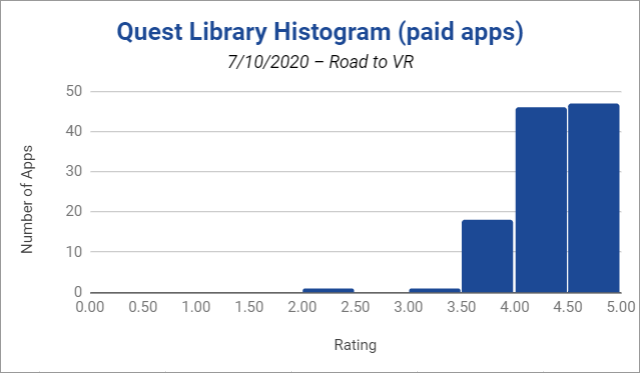
While Oculus doesn’t offer much publicly in the way of understanding how well individual apps are performing across its VR storefronts, it’s possible to glean some insight by looking at apps relative to each other. Here’s a snapshot of the top 20 Oculus Quest games and apps as of July 2020.
Some quick qualifications before we get to the data dump:
Paid and free apps are separated
Only apps with more than 100 reviews are represented
Rounded ratings may appear to show ‘ties’ in ratings for some applications, but the ranked order remains correct
Best Rated Paid Oculus Quest Apps
The rating of each application is an aggregate of user reviews and a useful way to understand the general reception of each title by customers.
Survivors Thrill of the Fight (↓3), Moss (≡), I Expect You to Die (↓1), SUPERHOT VR (↑1), Pistol Whip (↑3), Kingspray Graffiti (↓5), Racket: Nx (↓4), Job Simulator (↑3), Real VR Fishing (↓2), Space Pirate Trainer (↓8), Red Matter (↓6)
Newcomers
The Room VR: A Dark Matter, Trover Saves the Universe, Down the Rabbit Hole, Pixel Ripped 1995, Vacation Simulator, Lies Beneath, Beat Saber, A Fisherman’s Tale
Dropouts
SculptVR, Keep Talking and Nobody Explodes, Gadgeteer, Shadow Point, Virtual Virtual Reality, Journey of the Gods, Fujii, Dreadhalls, Sairento VR: Untethered
FitXR, the studio behind VR fitness app BoxVR, today announced that it has raised $7.5 million to expand its operations and VR fitness offerings.
Following its first raise of $1.25 million at the end of 2018, FitXR has just added another $7.5 million worth of runway to its VR fitness aspirations. The total comes in the form of a $6.3 million Series A investment and a $1.2 million loan through a government-based UK innovation fund.
The Series A investment was led by Hiro Capital; the fund has also invested in VR startup LIV which focuses on mixed reality capture for VR experiences (including BoxVR). BoostVC, Maveron, and TenOneTen Ventures also participated in the round.
Available on Oculus Quest, Rift, Steam, and PSVR, the $30 BoxVR app is presently the company’s only product offering. It’s a rhythm-based boxing game designed specifically for fitness. Its track-based levels—which include punching, crouching, leaning, and blocking—range from the length of a typical song to longer endurance-focused levels going as long as 60 minutes.
FitXR says it plans to use its latest investment to expand its European and North American operations, and to “accelerate [the] launch of several exciting new products and services for people to keep fit in virtual reality.”
While BoxVR is currently structured as a one-time purchase (with optional DLC), we wouldn’t be surprised to see this investment used to transition the app (or its successor) to a subscription-based model to capitalize on recent digital fitness trends and the app’s never-ending replayability.
Competing VR fitness app Supernatural made waves earlier this year as the first VR fitness app to be fully built around a subscription model.
While BoxVR doesn’t have the same popularity as, say, Beat Saber, the latest investment suggests that the app is seeing promising usage metrics (like consistent usage and long sessions) that have investors excited.
Tequila Works today announced that their VR murder mystery game The Invisible Hours (2017) is making its way to Oculus Quest “soon,” the studio says.
The Invisible Hours offers up a unique time-bending gameplay mechanic, which lets the user freely explore the complex Clue-style ‘whodunit’ as an apparition—sort of like an immersive theater piece that you can control, rewind, and experience at your own pace. You follow suspects around and slowly unravel the multi-thread murder mystery.
The Invisible Hours is also a triumph in character animation and overall graphical fidelity. In a Gamasutra post, the creators speak a little about the game’s traditional facial and motion capture of live actors.
“On the shoot, we had to track data very, very carefully: the project amounts to an unprecedented 2,240,000 frames of character data in Motion Builder. As such, it proved to be one of the most complex motion capture shoots in videogame history. But once processed, it was a relatively conventional pipeline to assemble the data inside the engine.”
There’s no timeframe on the Quest port yet, only “soon.”
With the unique ability to control time with your movements, SUPERHOT VR (2016) can make you feel like you’re in The Matrix. It’s on all major VR platforms, which cemented the studio a whopping $2 million revenue over the 2019 holiday season alone. Since then, the indie studio behind the game has been relatively quiet about the potential for future VR projects. Although there’s been some talk of VR being a possibility for its SUPERHOT: MIND CONTROL DELETE expansion, it seems it just isn’t in the cards—at least for now.
Update (July 10th, 2020): The news was served up yesterday that MIND CONTROL DELETE would come to PC and console on July 16th, free to all owners of the base game before that date. And no, it doesn’t seem a VR version is being planned for what the studio calls a “standalone game set in the world of Superhot.”
The studio responded directly to fans asking for an update on their VR plans, casting doubt on whether we’ll ever get a VR adaptation of the franchise’s next big installment.
No plans for VR at this time. Y'all will know if and when that changes!
Original article (September 11th, 2018): Despite the overwhelmingly positive reception of Superhot VR on all platforms, the studio has so far said that the upcoming standalone expansion, Superhot: Mind Control Delete will not include a VR component. The studio describes the expansion, which is currently available in Early Access, as a “rogue-like twist on the linear nature of the original SUPERHOT.”
A VR version of Mind Control Delete might not be completely off the table however. Speaking tothe official Vive Blog—for the occasion of Superhot VR becoming available on Viveport—PR Manager Szymon Krukowski of the SUPERHOT Team indicates that consumer interest will play a factor in whether the expansion sees VR support.
“Honestly for now we are focusing on MIND CONTROL DELETE but at the same time we never really left VR. If there is enough interest in [MIND CONTROL DELETE] we might try recreating something similar for VR,” Krukowski said.
When asked what’s next for the studio, Krukowski confirmed there are some prototypes in the works beyond Mind Control Delete.
“Most of the team is deep in developing SUPERHOT: MIND CONTROL DELETE,” said Krukowski. “At the same time though we are working on a few prototypes. Some of those are really hard to call games even. Piotr [the studio’s game director] is always doing something on the side. He doesn’t stop. It is almost compulsive. We love to experiment, create stuff that is engaging for us. Honestly though let’s finish [Mind Control Delete] and than see what happens.”
It’s interesting that Krukowski says the studio “never really left VR.” This may refer to the other projects the studio is working on; earlier this year a job posting indicated the company was seeking a Producer for “a shiny new VR project,” and the studio further said that their next VR title would not be a sequel to Superhot VR, but “a proper evolution.”
It’s our understanding that the original development of Superhot VR was funded by Oculus Studios; given the apparent success of that project, it’s possible the pair are working together again on something separate from Mind Control Delete, though nothing has been announced. Maybe we’ll hear something at Oculus’ Connect developer conference later this month?
Sony Corporation announced today that it will invest $250 million in Epic Games, the company well known for its hit game Fortnite and the Unreal Engine game engine that powers it. Unreal Engine is the second most popular game engine for building VR content, and has powered PSVR games like Farpoint, Moss,and Firewall: Zero Hour.
Interestingly, the investment in Unreal Engine is being made on behalf of a wholly-owned subsidiary of parent company Sony Corporation rather than by Sony Interactive Entertainment (AKA PlayStation). Whether that’s for legal structure reasons, or because the company plans to leverage its new stake in Epic Games beyond just gaming isn’t clear.
Going Beyond Gaming
While Epic’s Unreal Engine is certainly most relevant to PlayStation and gaming, the engine is increasingly seeing use in non-gaming contexts like visualization and virtual film production, both of which have clear relevance to Sony Pictures (the company’s film division) and Sony Corporation (which focuses on the company’s consumer electronics business).
But it’s clear that the nearer implications of the investment will be on the interactive side of things, of which the company’s PlayStation 4 console is a major platform for Epic’s massively popular game, Fortnite. In recent years the game has broken new ground as a sort of proto-metaverse by hosting interactive events like virtual concerts, film debuts, and more to the game’s tens of millions of active players.
A virtual concert hosted in ‘Fortnite’ drew tens of millions of users last year | Image courtesy PCGamesN
“Epic’s powerful technology in areas such as graphics places them at the forefront of game engine development with Unreal Engine and other innovations. There’s no better example of this than the revolutionary entertainment experience, Fortnite. Through our investment, we will explore opportunities for further collaboration with Epic to delight and bring value to consumers and the industry at large, not only in games, but also across the rapidly evolving digital entertainment landscape,” said Sony Corporation’s CEO, Kenichiro Yoshida.
Notice that Yoshida calls Fortnite a “revolutionary entertainment experience,” rather than a “revolutionary game.” This is a key hint about the company’s future ambitions.
“Sony and Epic have both built businesses at the intersection of creativity and technology, and we share a vision of real-time 3D social experiences leading to a convergence of gaming, film, and music. Together we strive to build an even more open and accessible digital ecosystem for all consumers and content creators alike,” said Epic Game’s CEO Tim Sweeney.
It’s the “convergence of gaming, film, and music” part which speaks to where the long-term synergies between Sony and Epic lie. Sony is a global player in all three of those spaces presently, and clearly has the vision of a future where these three sectors meld far closer together than ever before. The foundation of that future, from Sony and Epic’s standpoint, appears to be interactivity and real-time rendering.
Unifying One of PlayStation’s Greatest Assets
Image courtesy PlayStation
Another, less lofty synergy between the companies could be that Sony Interactive Entertainment (SIE) wants to move its first-party game studios away from proprietary in-house game engines and toward Unreal Engine to increase cohesion and leverage game-engine R&D across studios.
SIE’s first-party studios have been increasingly important for PlayStation over the last console generation, having given the company’s console a significant edge thanks to exclusive hit titles like Uncharted 4, Horizon: Zero Dawn, Marvel’s Spider-Man, God of War,and The Last of Us Part 2.
The growing importance of company’s first-party game studios to Sony’s console business was made even more apparent when it was recently announced that the company will rebrand the studio group from Sony Interactive Entertainment Worldwide Studios to, simply, PlayStation Studios.
While Sony may well want to leave the studios’ present level of autonomy untouched (including their choice of using different in-house engines), it’s clear how moving the group toward a singular game engine would capitalize on existing investments by allowing studios to much more easily share both engine technology and developer talent. Unifying under a single game engine would mean less replication of game engine R&D as much as developer training and experience.
EA’s Game Engine Case Study
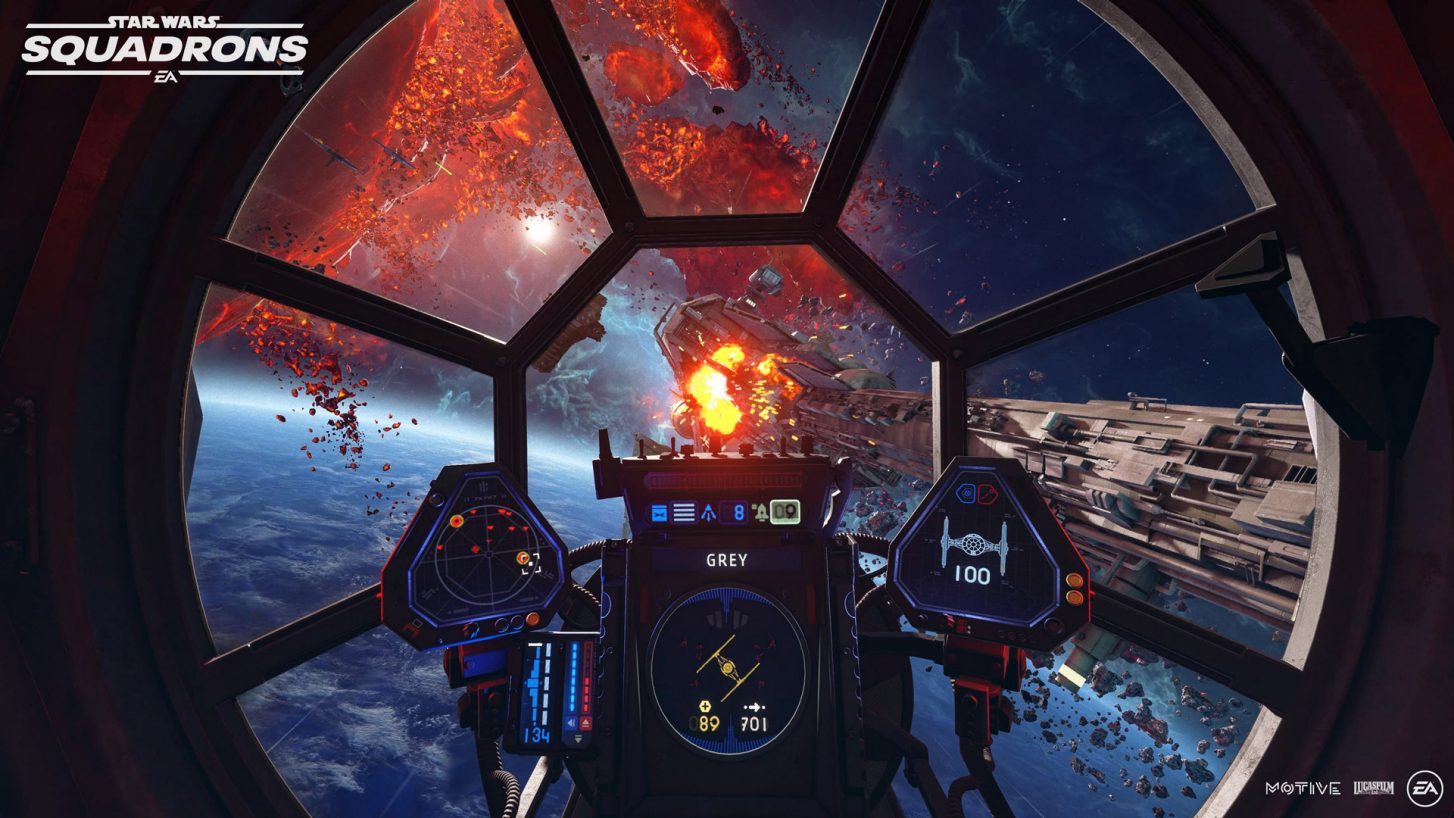
‘Star Wars: Squadrons’, powered by EA’s Frostbite engine, will support VR headsets | Image courtesy Motive
Mega-game publisher Electronic Arts pulled a similar move when it acquired DICE, the studio behind Battlefield, back in 2006. The acquisition not only brought the popular game franchise under EA’s umbrella, but also the studio’s Frostbite game engine. Since then EA has leveraged that acquisition by investing deeply in Frostbite and making it widely used across the company’s studios.
Frostbite now powers many EA-published game franchises like Mass Effect, Madden NFL, FIFA, Need for Speed, and, of course, Battlefield. The engine has even been adapted for use with VR; it will power the upcoming VR-supported Star Wars: Squadrons, and was already used in Star Wars Battlefront Rogue One: VR Mission (2016) which was released for PSVR.
Streamlining EA studios with Frostbite as a technological foundation has been a clear success as the company and the engine has been behind some of the most visually ambitious games ever made—Battlefield 5 (2018) being a stunning example.
What It Could Mean for VR
Image courtesy PlayStation
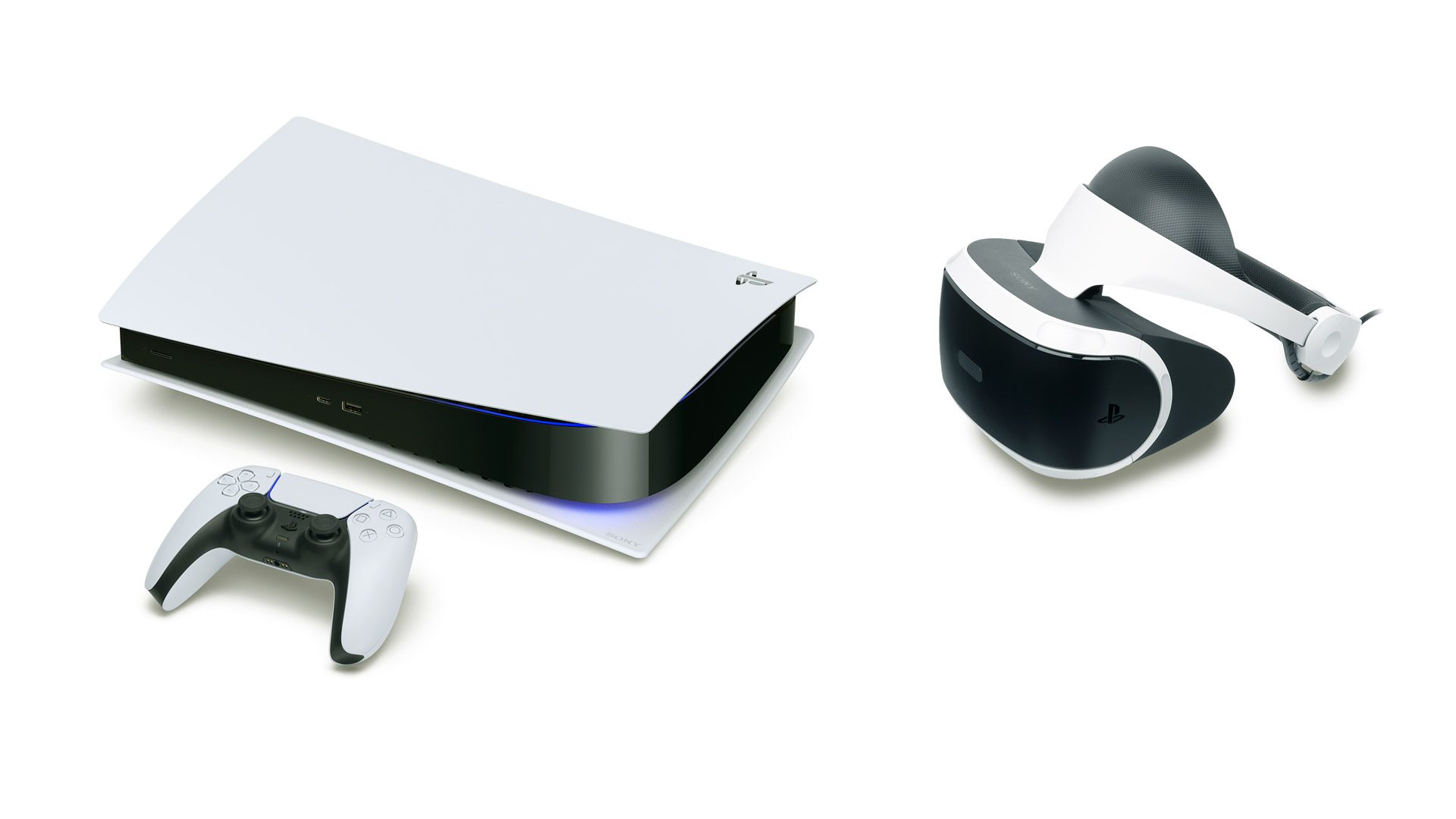
If Sony moves toward making Unreal Engine the engine of choice for PlayStation Studios, it could also impact the company’s VR strategy. Unreal Engine already supports VR development across all major headsets, including PSVR. It has powered PSVR games like of Farpoint (2017), Moss (2018), and Firewall: Zero Point (2018).
While some PlayStation Studios teams have released VR games—like JAPAN Studios’ ASTRO BOT: Rescue Mission (2018) and London Studios’ Blood & Truth (2019)—still many of the company’s studios have not.
While adapting a studio’s in-house game engine for VR rendering isn’t necessarily the hardest part of developing a VR game, building into that engine a full suite of developer tools to meet the specific needs of VR development is a much larger task. Fortunately, it’s something that Epic Games has been doing with Unreal Engine for years. In fact, the company released its own VR game, Robo Recall (2017), which still stands as an impressive example of the engine’s VR prowess.
Streamlining PlayStation Studios with Unreal Engine would mean that all of Sony’s game studios would already be working with a game engine that has fully-featured VR capabilities; that would reduce the friction for the company’s other studios to commit to building VR games.
Unreal Engine on PlayStation 5
‘Lumen in the Land of Nanite’ an Unreal Engine 5 tech-demo that debuted on PS5 hardware | Image courtesy Epic Games
Unreal Engine isn’t just relevant to PlayStation Studios, it’s also relevant to Sony’s upcoming PS5 and its community of third-party developers. Even prior to today’s investment announcement, Sony had already been apparently working in close collaboration with Epic to optimize Unreal Engine for PS5’s new hardware architecture.
The demo showed off key new features of the upcoming Unreal Engine 5: advanced lighting thanks to dynamic global illumination and incredible geometric detail with ‘virtualized micropolygon geometry’, which Epic says will allow “film-quality source art comprising hundreds of millions or billions of polygons” to be imported into Unreal Engine 5 and run in real-time.
Epic says that theses features will be supported in VR content, though it isn’t clear how much they will be limited by VR’s high-performance requirements.
– – — – –
And we haven’t even really touched on the Epic Game Store, the company’s new digital distribution platform which has brought much needed competition to Steam’s dominance.
Overall, Sony’s investment in Epic is an ambitious move and one which will have nearer-term and decades-long implications for Sony and Epic Games, both of which are deeply intertwined with the VR industry. While Microsoft is only just catching up to the powerhouse of development talent that’s accumulated in PlayStation Studios, this forward-looking move may well keep PlayStation one step ahead of its competition in the next generation.
This video shares how I record gameplay audio on the Oculus Quest for those who are looking to record or live stream via their PC. This gets you better control and allows you to live stream on more platforms than just Facebook! ► Check out our VR equipment → https://www.amazon.com/shop/caschary Now, here’s the thing. When capturing gameplay with adb and thus this method with SideQuest, then gameplay audio does -not- come with it, unfortunately. So this video shows you what I do to capture both video and sound for our live streams. Sorry, this is a little later than expected. I hope you forgive me. But I get this question a lot, so it’ll be nice to have a video to link to from now on. TIMESTAMPS 00:00 Intro 00:36 Who Is This Video For? 01:33 What Tool We Use 02:08 Getting Started 02:52 The Problem 03:00 The Solution 05:44 Extra Tips & Tricks 07:38 Other Options To Capture Audio 08:38 Outro LINKS * ► Previous video - How To Sideload & Stream Using SideQuest: https://youtu.be/reH55tb9w84 ► Previous live stream - https://www.youtube.com/watch?v=Xqte9cdWTik ► Fotowelt Wireless Lav Mic: https://amzn.to/3iP9awM ► Rode Wireless Go: https://amzn.to/38IDnJs ► Aux Cable (Any should work): https://amzn.to/2ZbpMHn I can't find my Delock USB Audio Adapter on Amazon (you could try any USB audio adapters that's available in your country). ► Get an Oculus Quest here (US): https://bit.ly/oculusquest-cc - Get an Oculus Quest (UK): https://amzn.to/2Jip6Zg - Get an Oculus Quest (NL): http://bit.ly/2QlCpd2 (Coolblue) SUPPORT THE CONTENT ► Become our Patron (includes exclusive rewards) → http://bit.ly/PatreonCasandChary ► Become a Sponsor on YouTube (includes exclusive rewards) → http://bit.ly/JoinCasandChary ► Check out our VR Merch → http://bit.ly/casandchary-merch USE OUR LINKS TO SUPPORT US ► VRcover → http://bit.ly/CCVRCover ► VR Prescription Lens Adapters (5% discount code: "CAS&CHARY") → http://bit.ly/CCWidmoVR ► Oculus Quest Comfort Counterweight (5% discount code: "CAS&CHARY") → https://bit.ly/studioform500 ► Play PC VR games with your Quest (10% discount code: "JWGTCASCHARY") → http://bit.ly/CCRiftcat ► More on our website → https://casandchary.com/discount-codes-affiliate-links/ OUR GEAR Our VR equipment → https://www.amazon.com/shop/caschary Full PC Specs → https://casandchary.com/vr-equipment/ GET LATEST UPDATES Twitter → https://twitter.com/CasandChary Facebook → https://www.facebook.com/casandchary/ Instagram → https://www.instagram.com/casandchary/ Join our Discord → https://discord.gg/YH52W2k A special thanks to these Patreon Champs for their support: - BaxornVR: https://www.youtube.com/channel/UC1tmq8Y3jC7gNGvW7asmv1Q - Wintceas - Studioform VR - Andy - Albert - Ben P. - Steve Dunlap - Thomas M. Rice - Andy Fidel - VR Balance - Nathan Schmidt MUSIC Music we use is from Epidemic Sounds → http://bit.ly/CCEpidemicSound DISCLAIMER This video was not sponsored. Links in this description may contain affiliate links. We may earn from qualifying purchases from these links (without costing you more). VR on! - Cas and Chary VR #guide #oculusquest #casandchary
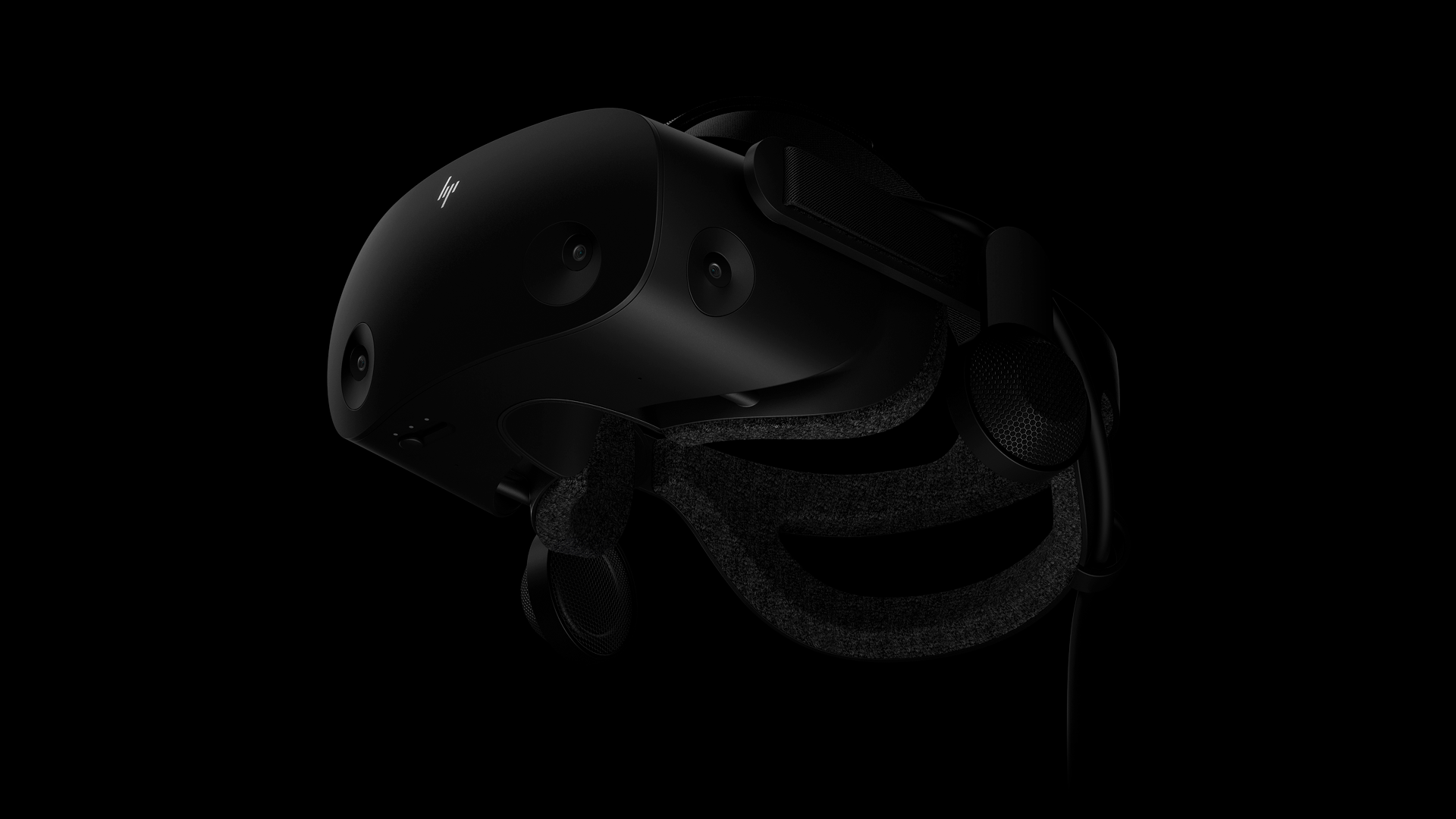
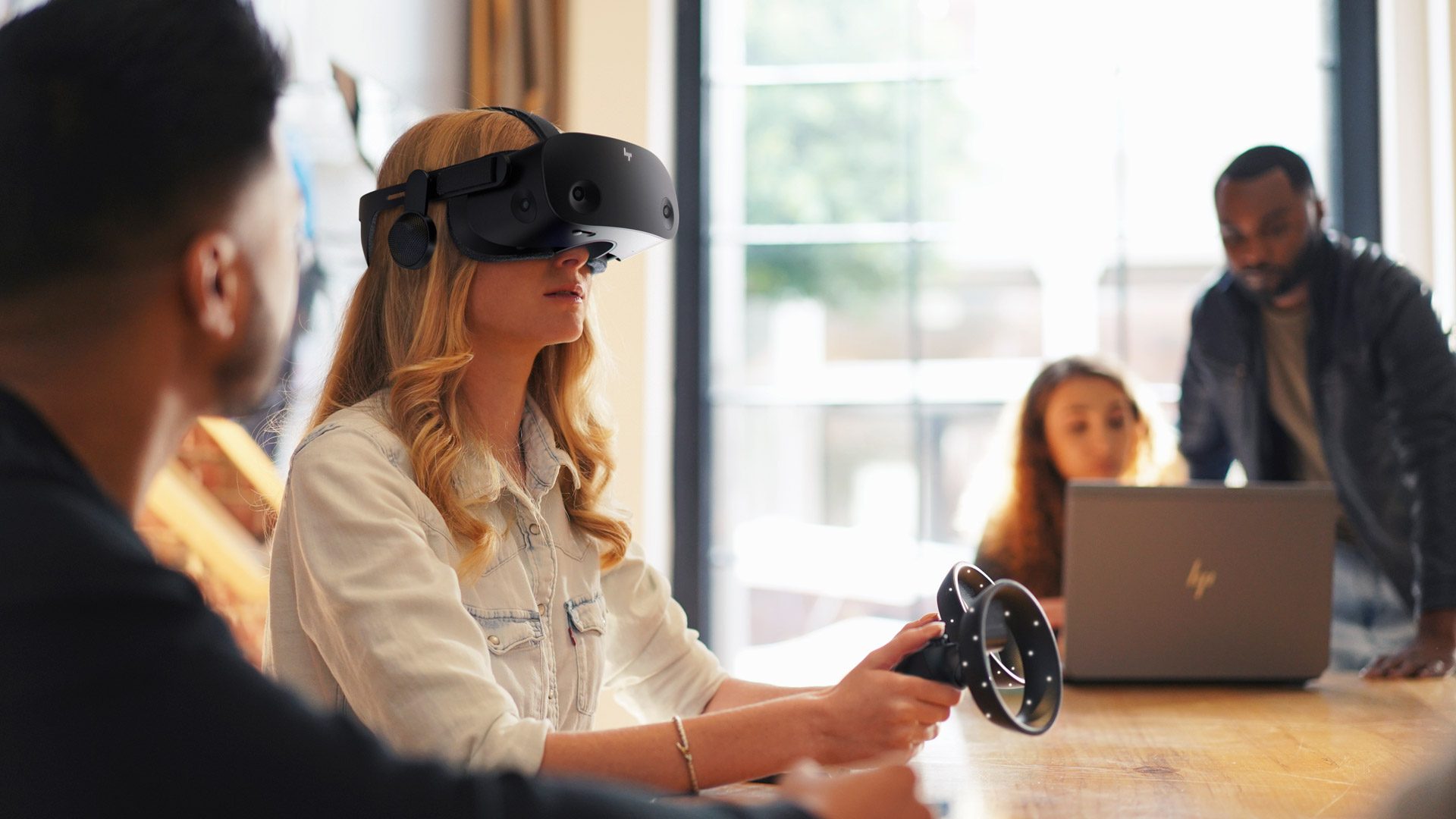
Back in late May, HP announced its was bringing another VR headset to market, the Reverb G2, which includes a veritable wishlist of improvements to the WMR product ecosystem. Now an official HP retailer in the UK has listed a September 15th launch date for the headset.
Update (July 9th, 2020): HP still lists the headset as “coming soon,” however HP’s UK-based official reseller Systemactive has pre-orders open for Reverb G2, priced at £525, which includes VAT and delivery within the UK.
The website also seems fairly sure of itself, as it proudly displays a countdown timer until pre-orders release to eager customers.
There’s still no word on when other regions will get an official launch date; we’ll have our eyes peeled leading up to the prospective fall launch date.
Original Ariticle (May 28th, 2020): With leading visual clarity, high quality off-ear headphones, improved tracking, and new controllers, there’s a lot to look forward to. The headset is available for pre-order starting today at $600 and is set to launch this Fall.
HP launched the original Reverb headset back in May, 2019; now just a year later the company is revealing its successor, the Reverb G2.
From the upgrades and improvements, it seems quite clear that HP has been listening carefully to feedback from users of the original Reverb and other WMR headsets at large. Reverb G2 is shaping up to be the next generation of Windows VR headsets.
Four Camera Tracking for the First Time on WMR
Reverb G2 has two cameras on the front and two on the sides | Image courtesy HP
Windows VR headsets were the first major headsets out of the gate with inside-out tracking back in 2017. While it was impressive for the time, competitors like Oculus have since launched headsets with four or more tracking cameras which offer a much larger tracking volume.
Reverb G2 is the first WMR headset to move from two-camera tracking to four-camera tracking. HP says that the additional cameras offer “1.4x more movement capture” compared to other Windows VR headsets.
New Controllers, Compatible with All WMR Headsets
Image courtesy HP
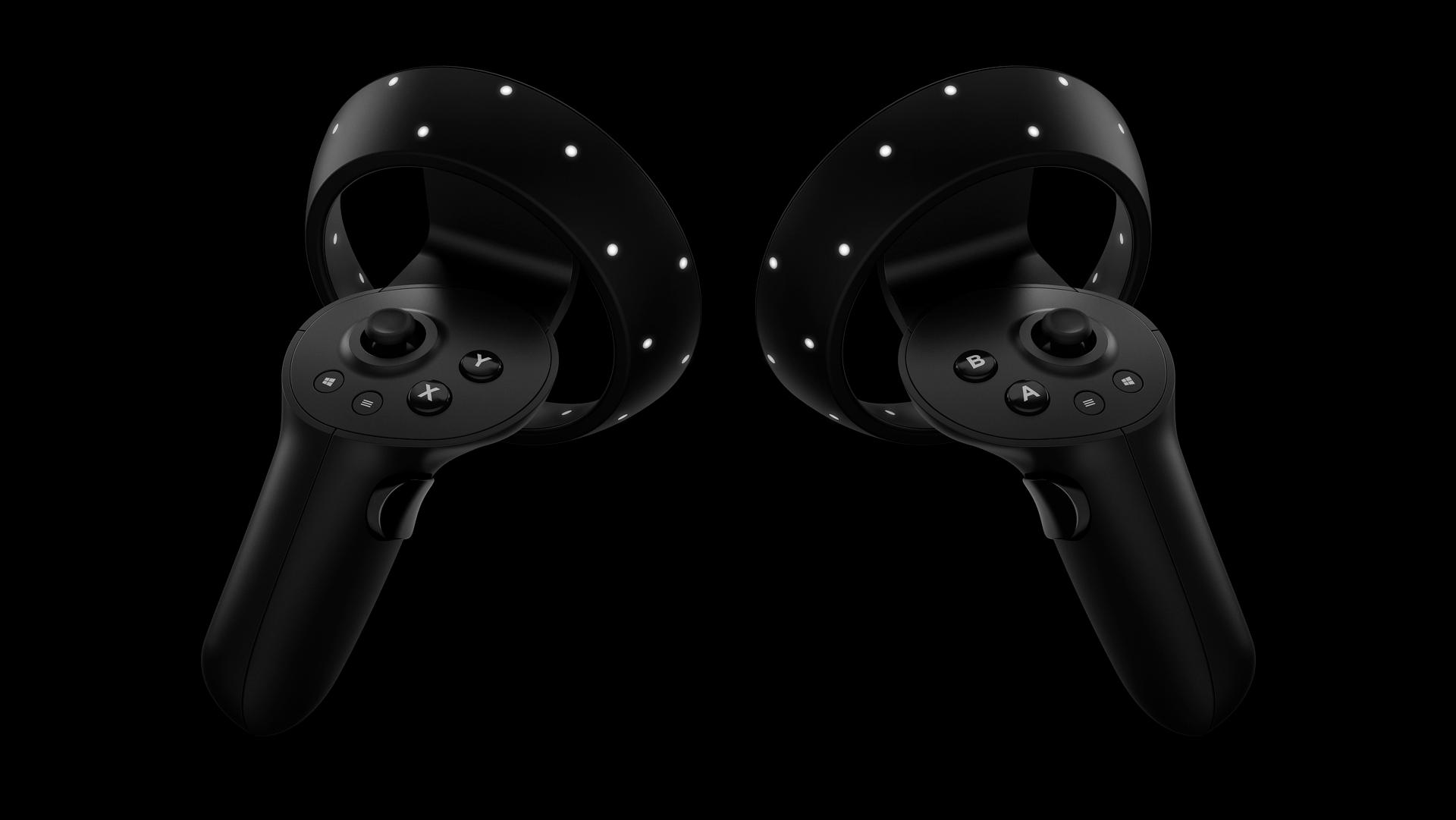
Reverb G2 will also be the first Windows VR headset to offer a substantial controller redesign. While Samsung made slightly more ergonomic versions of the original Windows VR controllers for its Odyssey headsets, HP is bringing significant changes to the shape and input layout.
The original WMR controllers had both a thumbstick, trackpad, and one application button on the face. That was accompanied by an analog trigger and a grip button.
The Reverb G2 controllers—which appear unabashedly shaped like Oculus’ Touch controllers—offer a much closer input layout to other modern VR controllers: a thumbstick, two face buttons, an application button, an analog trigger and a grip trigger. There’s also the ‘Windows’ button for core WMR functionality.
What’s more, HP says that the G2 controllers are backwards compatible with other Windows VR headsets, which means that WMR users who are happy with their current headset will have an option to upgrade their controllers. HP says it plans to sell the G2 controllers separately from the headset for this purpose, but that may not happen until sometime after the launch of the headset, and pricing for the controllers alone has not been announced.
Impressive New Display & Optics
Image courtesy HP
In the display department, Reverb G2 technically has the same resolution as the original Reverb (2,160 × 2,160 per-eye), but it’s an all new display which brings some key improvements over the original. HP says it has better contrast, brightness, and lower persistence.
Part of why Reverb is leading the pack in clarity is because its displays are not just higher resolution but also smaller than some other headsets, making the pixels per degree higher than if they were spread over a larger field of view. HP says Reverb G2 maintains the same 114-degree field of view as the original Reverb (which we’ve found to be comparable in FOV to Oculus’ headsets).
New Off-ear Headphones, Courtesy Valve
Image courtesy HP
HP makes no secret that it has worked directly with Valve on Reverb G2, and that’s meant adopting Index’s impressive ‘off-ear’ headphones.
The original Reverb headphones gave us nothing to complain about, and were quite a bit better than the default audio in Oculus’ latest generation of headsets. Even so, G2 is bringing upgraded headphones to the table.
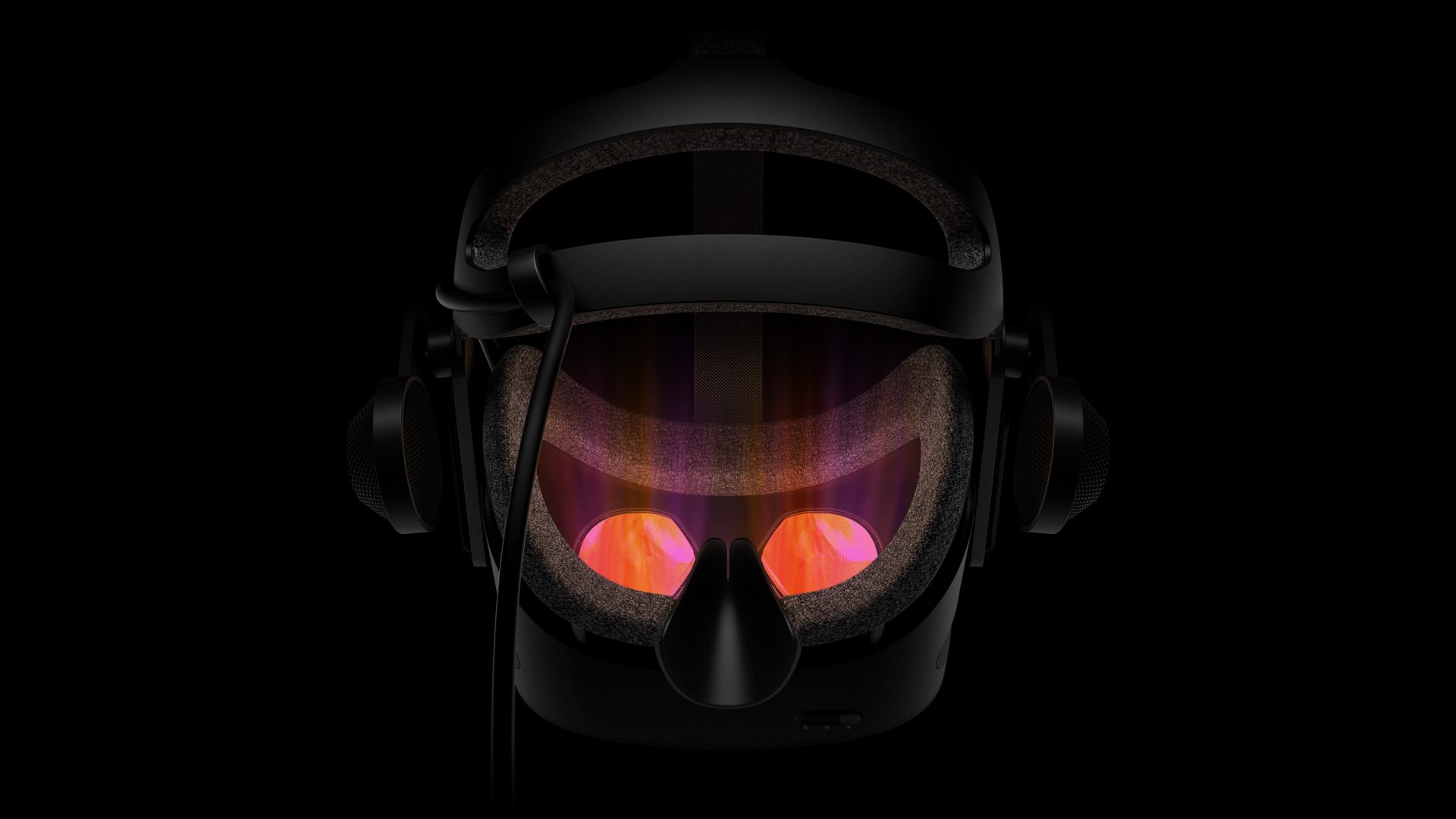
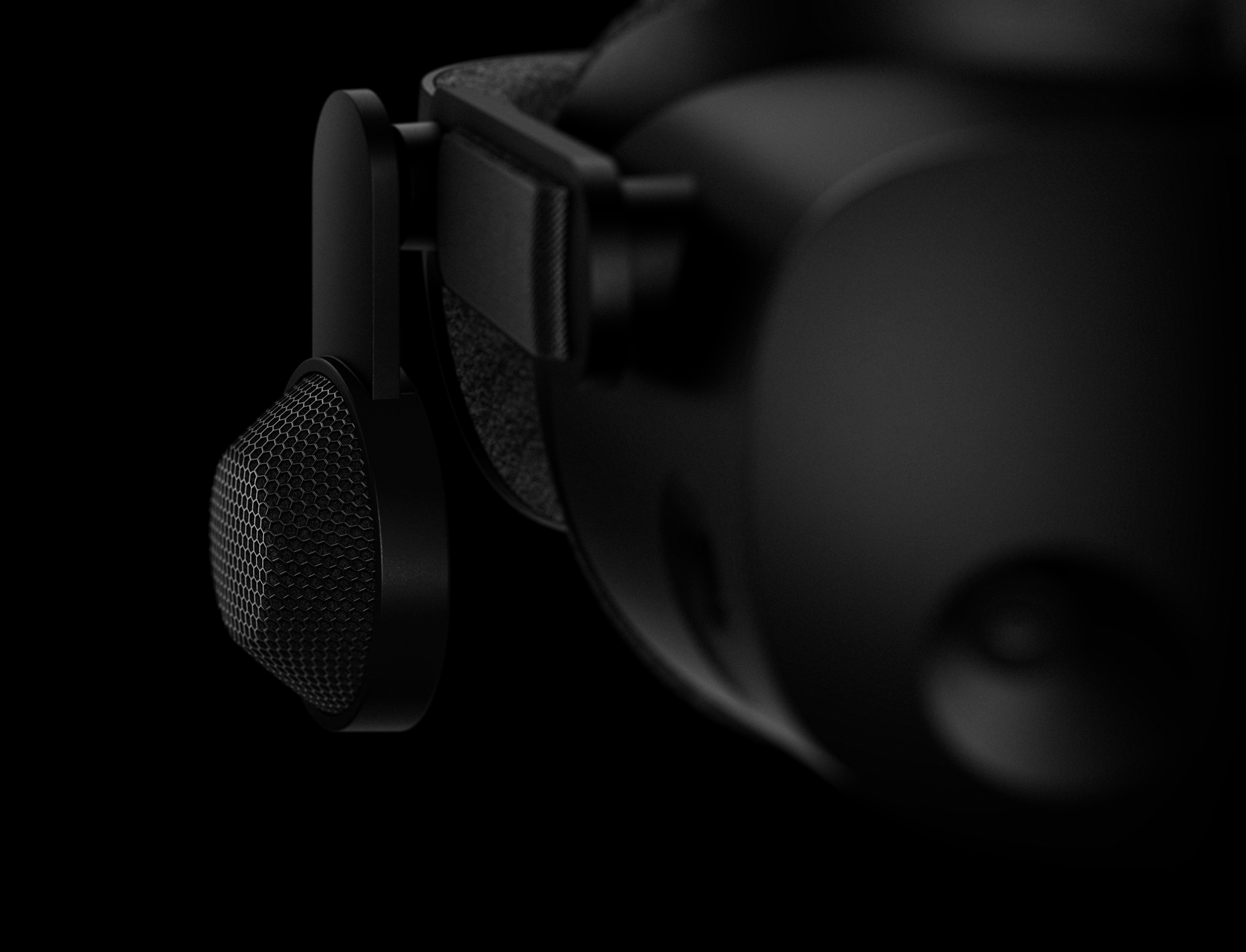
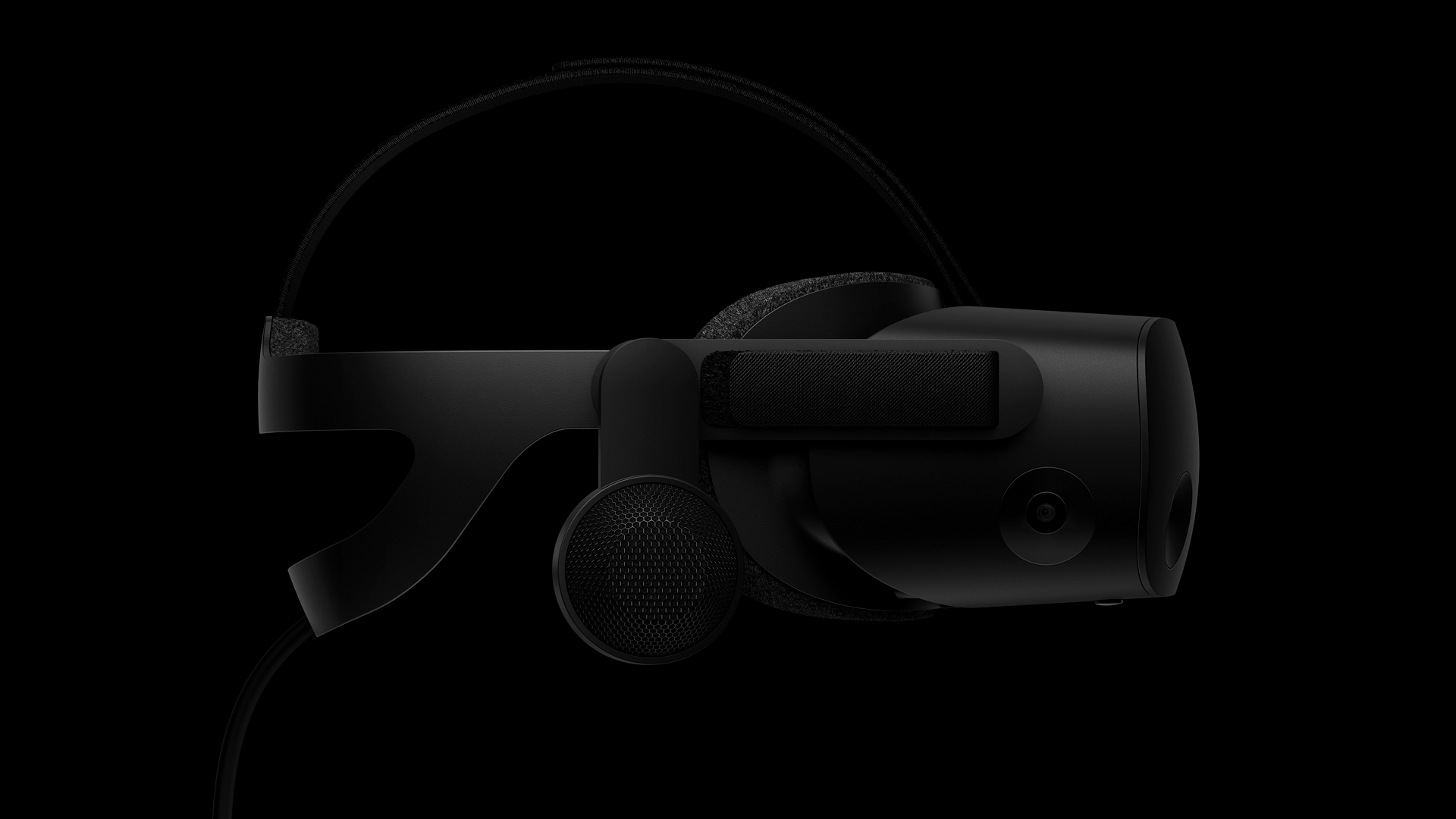
HP tells us that these are the exact same amp and drivers that have made Index the audio king among VR headsets. The G2 headphones also adopt the smart ‘off-ear’ mounting approach which we’ve found on Index to be more comfortable and even more immersive than ‘on-ear’ headphones.
Also pulling a few pages from Valve’s playbook, Reverb G2 has a redesigned head-mount shape, improved padding, and a magnetically attached face-gasket.
The circle design on the rear of the original Reverb has been eschewed in favor of a wider oval which the company says is better shaped to the head. The new padding is notably thicker and wider, better distributing pressure around the eyes and back of the head.
While G2 is borrowing some ergonomic notes from Index, HP’s new headset will retain the side-strap approach for fitting and tightening the headset rather than a tightening dial which has become popular on recent headsets.
G2 thankfully also adds a physical IPD adjustment which allows users to change the distance between the lenses from 60mm to 68mm. This is an important feature for allowing users to get their eyes aligned with the ‘sweet spot’ of the lens.
The headset’s display housing can also rotate 90 degrees relative to its head-mount. This isn’t the ‘flip-up’ function offered by some other headsets, but it adds more flexibility when putting on the headset.
Reverb G2 also brings a lengthy 19.5 foot (6m) cable which is thinner and lighter than the somewhat bulky tether on the original Reverb. The cable connects to PCs via DisplayPort and USB-C; if the USB-C port can’t provide adequate power, an included power adapter can be connected to the tether. HP also noted that the new cable has been redesigned to eliminate the display issues that plagued early models of the original Reverb.
HP Reverb G2 Price, Pre-order, and Release Date
Image courtesy HP
HP has priced Reverb G2 at $600, the same as the consumer version of the original Reverb. The headset’s release date is planned for Fall 2020.
The company is taking pre-orders for G2 in the United States starting today at HP.com, Steam, and “select channel partners.” The company says pre-orders for other “select countries” are expected to open between mid-June and July.
HP Reverb G2 Specs
Platform: WMR (with SteamVR compatibility)
Resolution: 2,160 × 2,160 LCD per-eye @ 90Hz
Field-of-View: 114°
Tracking: Inside-out, four cameras
Weight: 1.21 pounds (0.55kg)
Cable Length: 19.5 feet (6m)
Connector: DisplayPort, USB-C, power adapter (optional) [DisplayPort to mini-DisplayPort adapter included]
Controllers: Removable batteries, 2x AA (included)