Monday, December 9, 2019

Google Unveils ARCore Depth API to Make AR More Natural & Interactive

ARCore, Google’s developer platform for building augmented reality experiences for mobile devices, is unveiling today a new tool called Depth API, which not only lets mobile devices create depth maps using a single RGB camera, but also aims to make the AR experience more natural, as virtual imagery is more realistically placed in the world.

Shahram Izadi, Director of Research and Engineering at Google, says in a blog post the new Depth API now enables occlusion for mobile AR applications, and also the chance of creating more realistic physics and surface interactions.

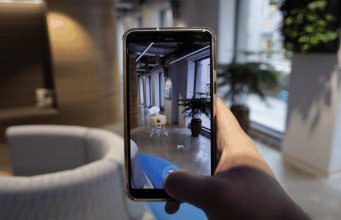
To demonstrate, Google created a number of demos to shows off the full set of capabilities the new Depth API brings to ARCore. Keep an eye on the virtual objects as they’re accurately occluded by physical barriers.

“The ARCore Depth API allows developers to use our depth-from-motion algorithms to create a depth map using a single RGB camera,” Izadi says. “The depth map is created by taking multiple images from different angles and comparing them as you move your phone to estimate the distance to every pixel.”

Full-fledged AR headsets typically use multiple depth sensors to create depth maps like this, which Google says was created on device with a single sensors. Here, red indicates areas that closer, while blue is for farther areas:


“One important application for depth is occlusion: the ability for digital objects to accurately appear in front of or behind real world objects,” Izadi explains. “Occlusion helps digital objects feel as if they are actually in your space by blending them with the scene. We will begin making occlusion available in Scene Viewer, the developer tool that powers AR in Search, to an initial set of over 200 million ARCore-enabled Android devices today.”

Additionally, Izadi says Depth API does’t require specialized cameras and sensors, and that with the addition of time-of-flight (ToF) sensors to future mobile devices, ARCore’s depth mapping capabilities could eventually allow for virtual objects to occlude behind moving, physical objects.

The new Depth API follows Google’s release of its ‘Environmental HDR’ tool back at Google I/O in May, which brought more realistic lighting to AR objects and scenes, something which aims at enhancing immersion with more realistic reflections, shadows, and lighting.

Update (12:10): In a previous version of this article, it was claimed that Google was releasing Depth API today, however the company is only now putting out a form for developers interested in using the tool. You can sign up here.

The post Google Unveils ARCore Depth API to Make AR More Natural & Interactive appeared first on Road to VR.


Ream more: https://www.roadtovr.com/google-depth-api-arcore-augmented-reality/

Friday, December 6, 2019

Quest Dominated Black Friday Search Volume in the US, Tied PlayStation VR Worldwide

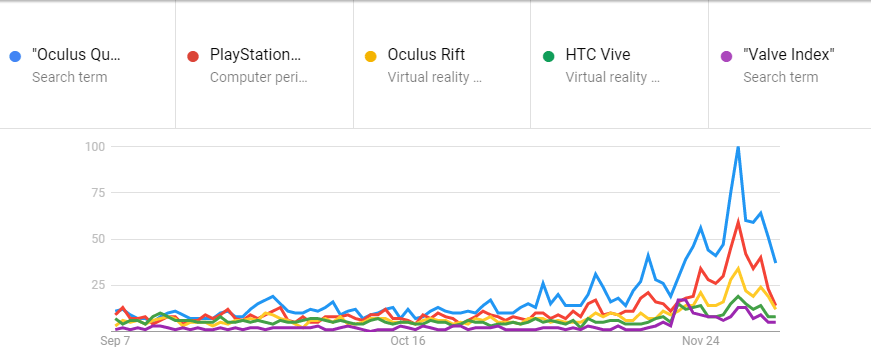
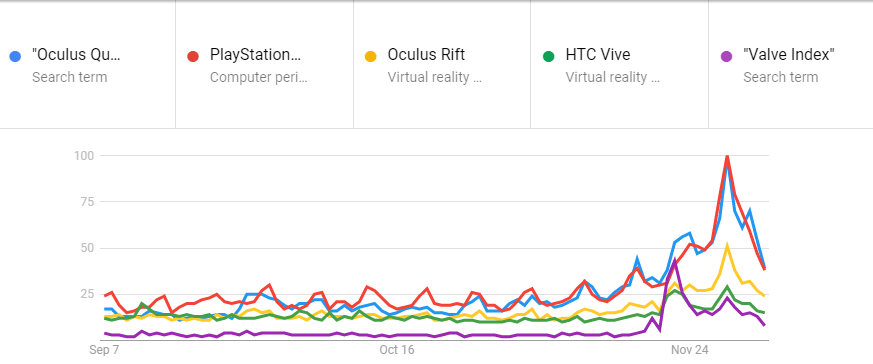
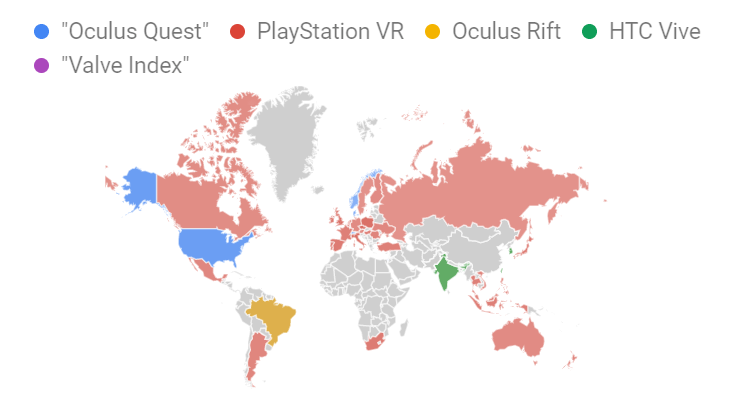
Though it’s Facebook’s newest headset, Oculus Quest may be the company’s most popular so far, at least as far as search volume is concerned. Kicking off the holiday shopping season on Black Friday, Quest dominated other VR headsets in search interest in the US. Worldwide, Quest tied with PSVR, the longstanding leader in holiday shopping search volume.

Relative Search Volume Among VR Headsets

When it comes to the most-searched-for headsets, there’s been three clear leaders during the 2016, ’17, and ’18 holiday shopping seasons: PlayStation VR, Oculus Rift, and HTC Vive. Released earlier this year, Oculus Quest has entered the fray and made a big splash. According to Google Trends, Quest dominated search interest in the US over Black Friday weekend which marks the start of the holiday shopping season.

US search volume, Black Friday weekend 2019 | Data courtesy Google

Peak search volume for Quest in the US was 1.6 times that of the next nearest headset, PlayStation VR, 2.9 times Oculus Rift, 5 times HTC Vive, and many times greater than other headsets like Valve Index, Oculus Go, Pimax, and Samsung Odyssey.

Worldwide search volume, Black Friday weekend 2019 | Data courtesy Google

When it comes to peak worldwide search volume over Black Friday weekend (which factors in PSVR’s significant popularity in Europe), Quest was nearly tied with PlayStation VR, both of which significantly led Oculus Rift, HTC Vive, Valve Index, and others by 2 times or more.

Most searched for headsets by region, Black Friday weekend 2019 | Data courtesy Google

What Can be Concluded from Search Volume?

Search volume is an interesting metric, but there’s too many variables at play here to determine which headset has actually sold best over the holiday period. For one, the data only includes searches through Google (though this covers 93% of all searches, according to StatCounter), and search volume is of course quite susceptible to marketing. So while we can see which headsets were the most popular in terms of searching, we can’t be sure how much of the volume is organic versus influenced by the amount of marketing money spent by Oculus, Sony, or others. We also don’t have a good way of knowing the rate at which searches actually convert to sales.

Among the leading headsets, only Sony has shared official sales figures for PSVR; the company announced back in March that it has sold-through 4.2 million PSVR headsets since the product’s launch in late 2016.

Data courtesy Sony, chart by Road to VR

Sony’s willingness to share PSVR sales figures over the years has signaled pretty clearly that the company believes it is far out ahead of other headsets in unit sales; whether or not Sony offers a similar update to PSVR sales figures in 2020 will be a strong indicator of how happy (or not) the company was with sales of the headset over the holidays.

Oculus and others have never provided official sales figures for their headsets, though the apparent success of Quest thus far could inspire Facebook to do so for the first time, likely sometime next year.

The post Quest Dominated Black Friday Search Volume in the US, Tied PlayStation VR Worldwide appeared first on Road to VR.


Ream more: https://www.roadtovr.com/oculus-quest-dominated-black-friday-search-volume-us-tied-psvr-worldwide/

Adobe Acquires Facebook’s ‘Oculus Medium’ VR Sculpting Tool

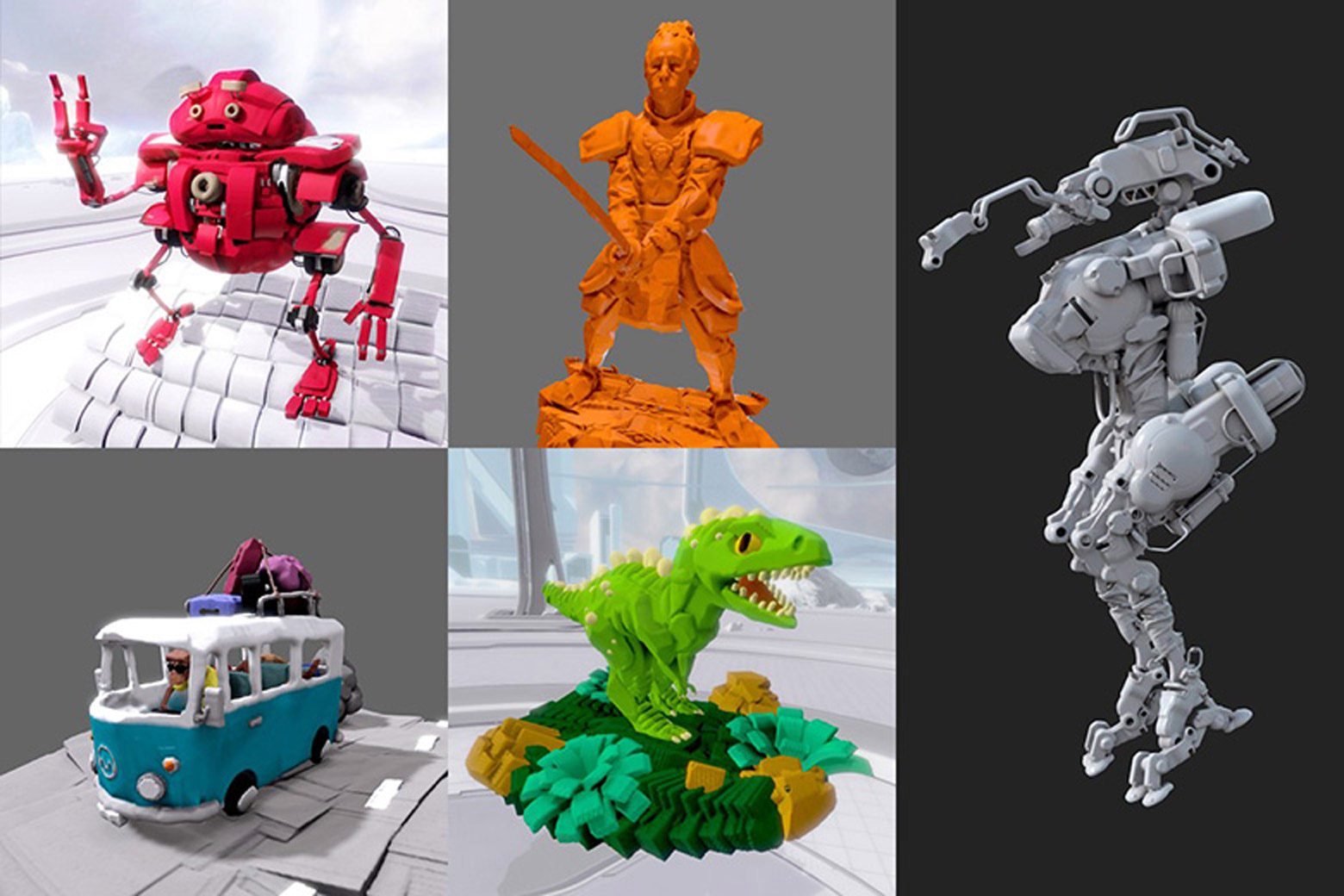
Facebook today announced that Adobe—the company behind industry-leading creative tools like Photoshop, Premiere, and Substance—has acquired Oculus Medium, the company’s VR sculpting tool.

Oculus Medium launched back in 2016 alongside the company’s Touch motion controllers, and began as an exploration of how VR could be useful beyond gaming and entertainment.

3D modeling on a computer is notoriously abstract compared to working with a physical medium; with VR’s unique, one-to-one perspective and input, Oculus set out to make a ‘sculpting’ tool which would feel more like working with clay in the real world than drawing primitive shapes and vertices with a mouse.

At launch Medium included a range of tools for making and forming 3D volumes. Models could also be ‘painted’ with spray paint-like control. The app also supported exporting of models so that they could be refined in other common 3D modeling and texturing tools, and ultimately used in production projects like games and films. Oculus continued to expand the app as VR’s potential for this sort of modeling work became increasingly clear. A Medium ‘2.0’ update launched in 2018, overhauling performance, UI, and tools.

Today Facebook announced that Adobe has acquired Medium; the price of the acquisition was not disclosed. Adobe is promising “continuity in the way [existing Medium users] access and experience the tool;” it remains available on the Oculus Store and will continue to be free for new activations of Oculus Touch.

What Will Happen to Medium Next?

Adobe says it “can’t wait to work with this community to keep Medium growing and improving,” so at least outwardly, the company is signaling that this isn’t a mere talent acquisition which would threaten to deprecate Medium and absorb its developers into other Adobe projects. Rather, Adobe says it plans to align the Medium team with its Substance team to “work together on the next generation of 3D tools” (Substance is a  3D tool widely used by game developers, which itself was acquired by Adobe in early 2019). This makes it sounds like Adobe wants to make Medium’s functionality part of the company’s broader 3D modeling offerings.

In the announcement shared by Oculus, the Medium team is calling this “a new chapter” for the tool, and says that users should “stay tuned for more features, improvements, and other developments coming from Adobe in 2020 as Medium continues to evolve.”

Who Wins?

At least from the outside, this actually looks like a win-win-win for Facebook, Medium, and Adobe. Medium has demonstrated itself as a unique and powerful creative tool, but this kind of product is quite far removed from Facebook’s core business; Medium‘s ultimate potential may have been stifled by a lack of interest from the parent company, and in a worst-case scenario, Medium—like Oculus Story Studio—might have been wound down and left to fade from existence. Rather than let that happen, Facebook found a way to let the project go without killing it outright.

Adobe’s entire business, on the other hand, is about making tools which empower artists and creators to produce great works. While the company’s foundation is in photography, videography, and print, in recent years it has clearly recognized opportunities in the 3D realm and has worked to aggressively expanded in that direction by building new tools—like Dimensions and Aero—and making acquisitions of companies like Mixamo, Allegorithmic (Substance), and now Medium. Under Adobe, Medium has a home where it could reach its true potential—becoming a core part of the 3D production pipeline—rather than a niche VR app.

What About Quill?

The news of this acquisition can’t help but turn eyes toward Quill, another Facebook-owned VR art tool with origins very similar to Medium.

Though they seem similar on the surface, Medium focuses primarily on a clay-like sculpting approach to 3D modeling while Quill is borrows more from the art of illustration, painting, and animation (even though it’s ultimately a 3D tool).

Quill was not mentioned in today’s announcement of Medium’s acquisition, but it’s hard to imagine that Quill isn’t in a similar position with regards to Facebook (a company which doesn’t seem to have a core business interest in helping Quill reach its ultimate potential as a powerful creative tool). If anything, the Medium acquisition seems to set the stage for some serious discussions about the future of Quill, and we wouldn’t be surprised to see a similar spin-out of the tool and team in 2020.

The post Adobe Acquires Facebook’s ‘Oculus Medium’ VR Sculpting Tool appeared first on Road to VR.


Ream more: https://www.roadtovr.com/adobe-acquires-facebook-oculus-medium-vr-sculpting-tool/

10 Best VR Games To Play On Oculus Link For Oculus Quest


It’s time for a list of 10 PC VR game suggestions to play with the Oculus Link for Oculus Quest. These are games that are great for the Oculus Rift S too! ► Check out our VR equipment → https://www.amazon.com/shop/caschary ► Subscribe to see more videos like this one → https://goo.gl/bSJ6L8 These are 10 games that you can definitely sink a lot of time into and that I have tested to work with the Oculus Quest. Do keep in mind that you still need a VR ready gaming PC to play these games with Oculus Link. TIMESTAMPS #1 - 00:40 #2 - 01:45 #3 - 02:58 #4 - 04:22 #5 - 05:41 #6 - 06:49 #7 - 08:21 #8 - 09:30 #9 - 10:46 #10 - 12:11 LINKS My favorite Oculus Link cable setup: ► Anker Powerline 6ft (US)- https://amzn.to/2CUpWqJ ► Anker PowerLine 6ft (UK)- https://amzn.to/2qu3fqP ► CableCreation Active USB Extension Cable 16ft - https://amzn.to/2r938Rf (US) ► AFUNTA 90 degree USB adapter 2 pack (US) - https://amzn.to/37MNWui ► AFUNTA 90 degree USB adapter 2 pack (UK) - https://amzn.to/2XTZN55 ► Oculus Quest Comfort Strap (5% discount code: "CAS&CHARY") → http://bit.ly/CCStudioformVR ► Velcro Hook and Loops (US) - https://amzn.to/33rMZUL ► Velcro Hook and Loops (UK) - https://amzn.to/2OS328W - Get the Oculus Quest (US) - https://amzn.to/2H5ECGx - Get the Oculus Quest (UK) - https://amzn.to/2Jip6Zg - Get the Oculus Quest (NL) - http://bit.ly/2QlCpd2 (Coolblue) SUPPORT THE CONTENT ► Become our Patron (includes exclusive rewards) → http://bit.ly/PatreonCasandChary ► Become a Sponsor on YouTube (includes exclusive rewards) → http://bit.ly/JoinCasandChary ► Check out our VR Merch → http://bit.ly/casandchary-merch USE OUR LINKS TO SUPPORT US ► VRcover → http://bit.ly/CCVRCover ► VR Prescription Lens Adapters (5% discount code: "CAS&CHARY") → http://bit.ly/CCWidmoVR ► Play PC VR games with your Quest (10% discount code: "JWGTCASCHARY") → http://bit.ly/CCRiftcat ► More on our website → https://casandchary.com/discount-codes-affiliate-links/ OUR GEAR Our VR equipment → https://www.amazon.com/shop/caschary Full PC Specs → https://casandchary.com/vr-equipment/ GET LATEST UPDATES Twitter → https://twitter.com/CasandChary Facebook → https://www.facebook.com/casandchary/ Instagram → https://www.instagram.com/casandchary/ Join our Discord → https://discord.gg/YH52W2k A special thanks to these Patreon Champs for their support: - artArmin - BaxornVR - Olemartinorg - Studioform VR - Wintceas - Andy - Albert - Ben P. - D Coetzee MUSIC Music we use is from Epidemic Sounds → http://bit.ly/CCEpidemicSound DISCLAIMER Links in this description may contain affiliate links. If you use it, a small referral fee will go to the channel, supporting the content without costing you anything extra. If you use it, thank you very much. VR on! - Cas and Chary VR #oculuslink #oculusquest #casandchary

‘Swords of Gargantua’ Gets Rogue-lite Adventure Mode in New Update

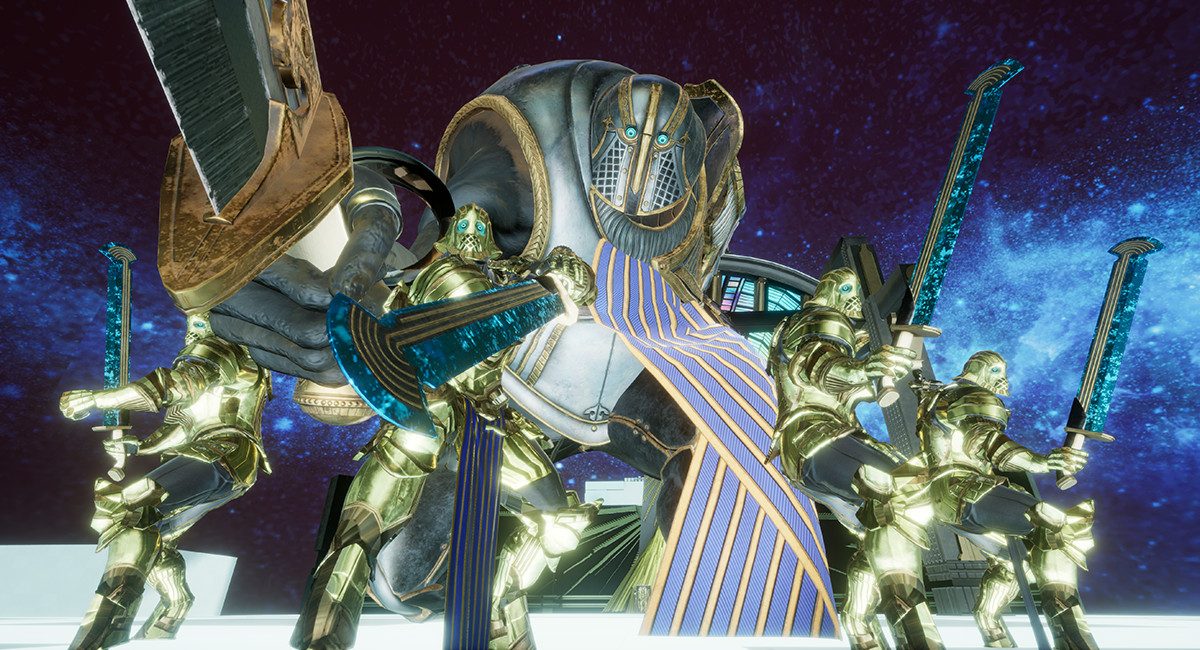
Swords of Gargantua (2019), the multiplatform combat arena from Yomuneco and gumi, now includes a new rouge-lite adventure mode that tasks players with going into what the studios call ‘The Tesseract Abyss’.

The new update is said to put players into the deepest layers of the 4D space known as the ‘Tesseract’, tasking players to earn weapons and coins while they battle increasing difficult foes along the way.

Available in both single and multiplayer, the Tesseract Abyss is now live on all supported platforms, which includes Steam and Viveport (Vive, Rift, Index, Windows VR), and the Oculus Store (Rift, Quest).

Tesseract Abyss Features

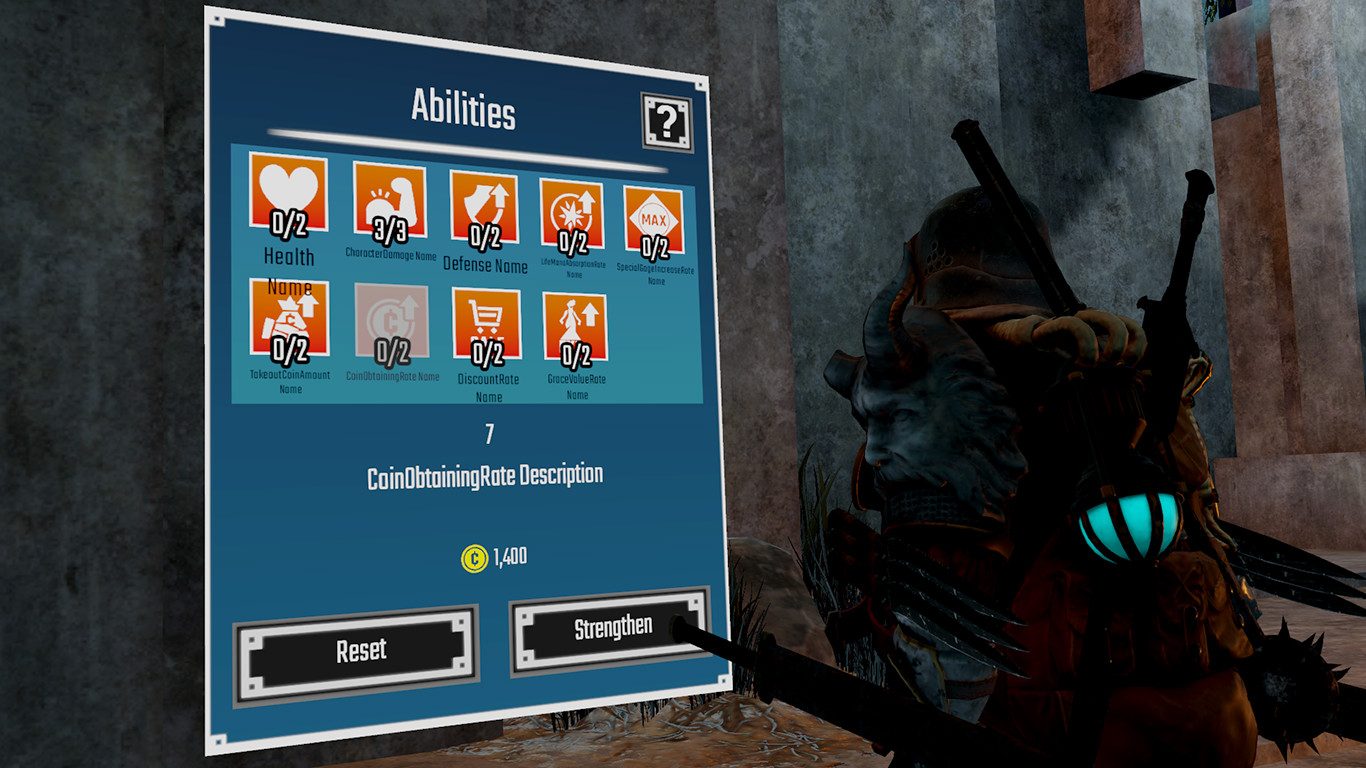
  • Level up your character – Player rank goes up as your performance does. As your rank increases so do abilities of your choosing.
  • Become stronger through your abilities – You can use your earned coins to strengthen your abilities, such as overall HP or your strength. Therefore, the more you play Tesseract Abyss the further you can progress!
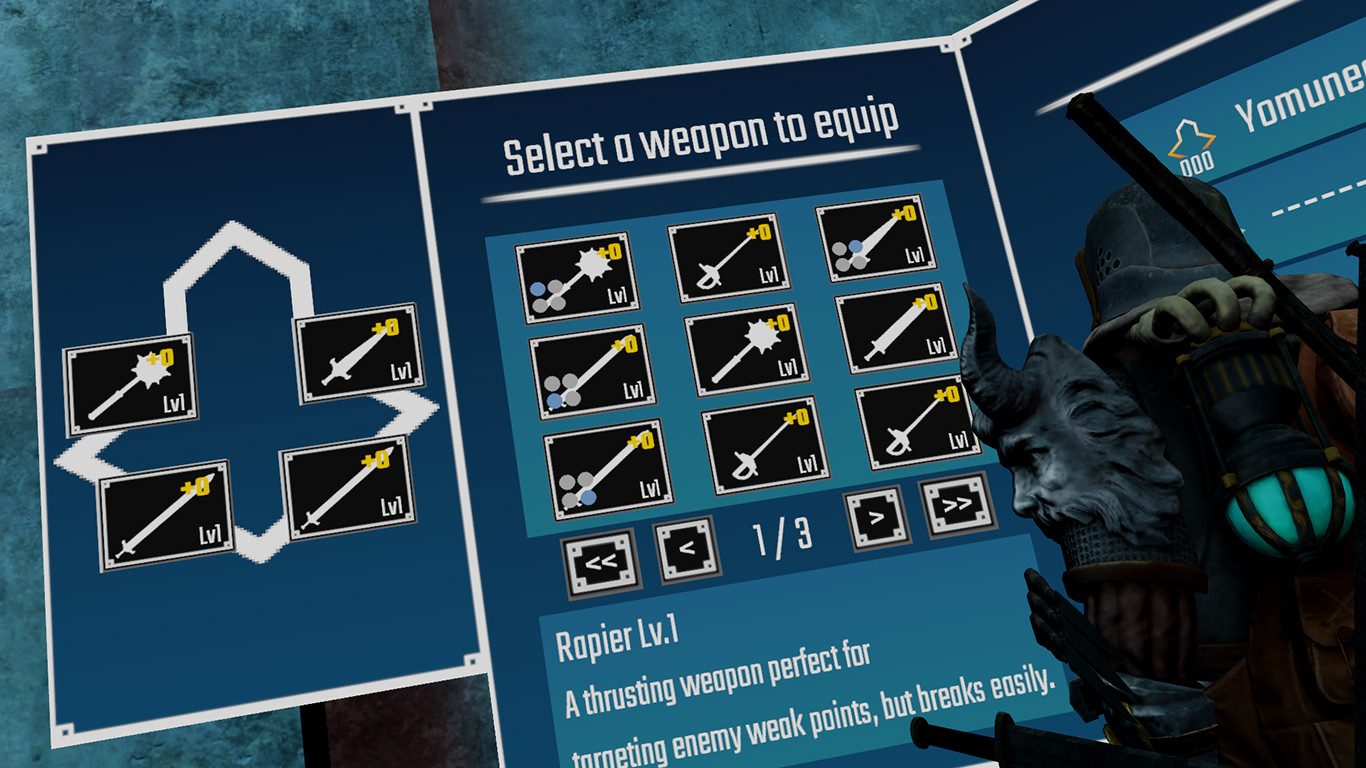
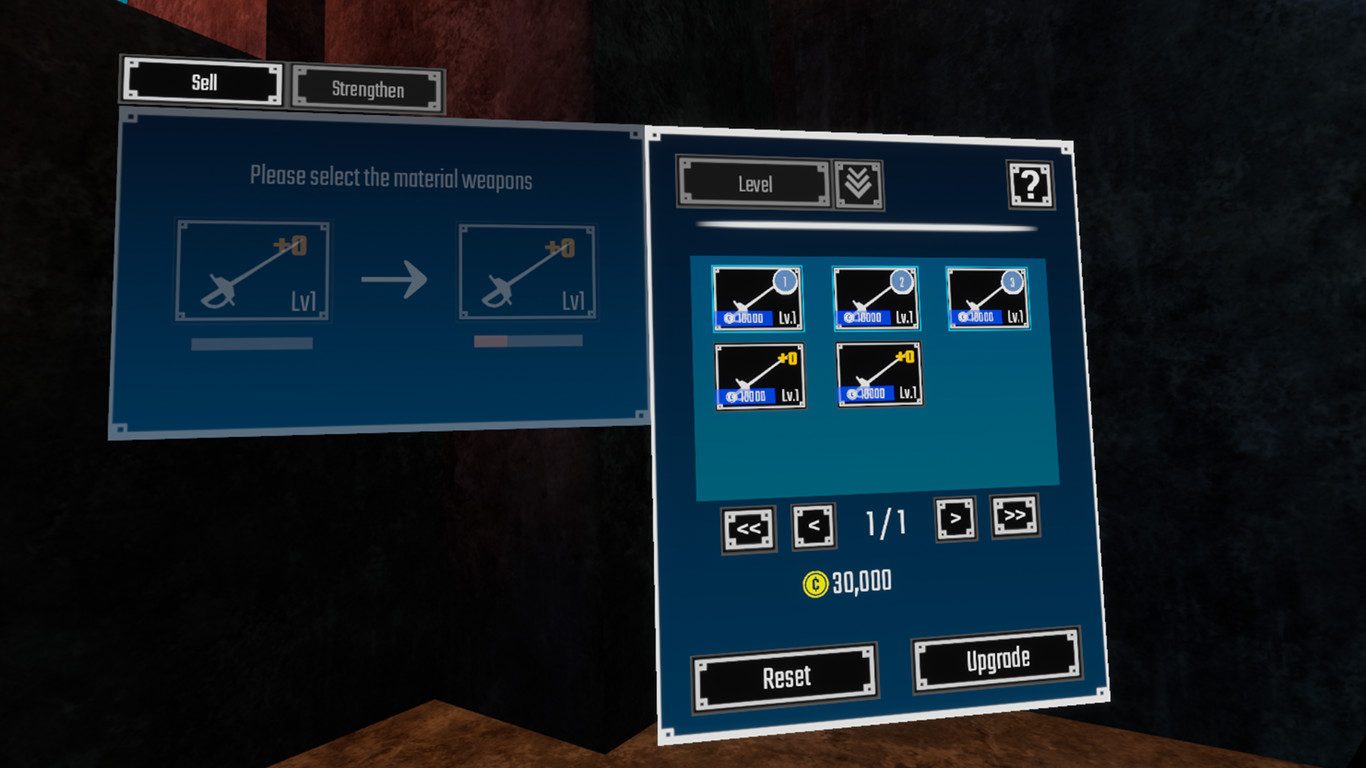
  • Increase strength through weapon crafting – You can combine duplicate weapons to make stronger versions of themselves. Depending on your strategy, you can collect and strengthen a lot of weaker type weapons or earn more powerful weapons later on and speed up the process.
  • Give yourself a temporary boost through artifacts – Artifacts are consumable items that players can purchase for temporary buffs, such as strength or health boosts. They can be purchased with coins and then brought into battles.
  • Carry items into the abyss – Bring your items and weapons into battle! Up to four weapons and/or artifacts can be brought into battle

The post ‘Swords of Gargantua’ Gets Rogue-lite Adventure Mode in New Update appeared first on Road to VR.


Ream more: https://www.roadtovr.com/swords-gargantua-adventure-mode-tesseract-update/

PSVR Support for ‘Dreams’ to Arrive Post-launch, Early Access Pricing Ends This Week

Media Molecule today announced that its creation-focused game Dreams is leaving Early Access soon, with its EA pricing coming to a close on December 8th. However the studio says the full version isn’t actually coming in December. And just as luck would have it, when the full version does arrive, it won’t support PSVR at launch.

Although somewhat confusing, Media Molecule announced that the last day you can purchase the Early Access version of Dreams will be December 8th, which is currently priced at $30.

There’s no official release date yet of the full version, which we imagine would come with a slight price hike. It’s unclear what updates are planned in the interim, although the studio says that EA players will still be able to play Dreams after the 8th and will upgrade to the full version when it launches for no extra cost.

Media Molecule Communications Manager Abbie Heppe confirmed with Road to VR that Dreams definitely won’t support PSVR at launch, although it is still planned.

Launched into Early Access on PS4 back in April, we were a bit dismayed that the studio didn’t include its long-promised VR support to the list of features, however Dreams was admittedly in an early, and unfinished state.

Heppe says in a PS blog post that on the road to releasing the full version the studio will be adding a non-motion control scheme for the game, helping new players learn to create, more tutorials and how-to content for players, improving existing features like Community Jams, the Homespace and Imp Quests and adding more content, including their “first piece of Mm story-telling in Dreams.”

The post PSVR Support for ‘Dreams’ to Arrive Post-launch, Early Access Pricing Ends This Week appeared first on Road to VR.


Ream more: https://www.roadtovr.com/dreams-psvr-support/

‘Apollo 11 VR’ Studio to Launch ‘Shuttle Commander’ Next Week on PSVR

Immersive VR Education, the studio behind VR experiences Apollo 11 VR (2016) and Titanic VR (2018), is set to launch its next mission into space on PSVR soon, this time taking you to the Hubble Space Telescope to go hands-on with an accurate recreation of the mission, shuttle cockpit, and space telescope itself.

Called Shuttle Commander, the experience is already live on the European PlayStation Store, and is slated to arrive to PSVR users in North America on December 11th, 2019.

Here’s how Immersive VR Education describes it:

Celebrate the discoveries and experience how this remarkable apparatus changed our understanding of the universe around us through science visualization segments which are based on actual data discovered by the Hubble Space Telescope over the past 3 decades.

Fly the space shuttle in an accurate physics based landing simulation and take control of the Canada Arm in space as you witness the Earth pass below during a full day / night cycle.

Shuttle Commander is also supposed to arrive on SteamVR headsets at some point, however the studio hasn’t mentioned when we should expect it to land.

The post ‘Apollo 11 VR’ Studio to Launch ‘Shuttle Commander’ Next Week on PSVR appeared first on Road to VR.


Ream more: https://www.roadtovr.com/shuttle-commander-psvr-rift-steam-vive-launch-date/

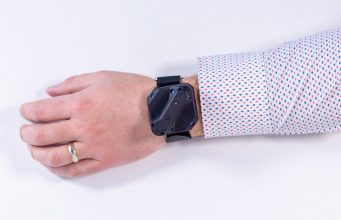
At $600K, Tundra Tracker Smashes Kickstarter Goal in Less Than 24 Hours

Tundra Tracker, the SteamVR Tracking tracker in development by Tundra Labs, has well exceeded its $250,000 Kickstarter goal in less than 2...